Every Link in the Chain: How God Built a Bridge to the World
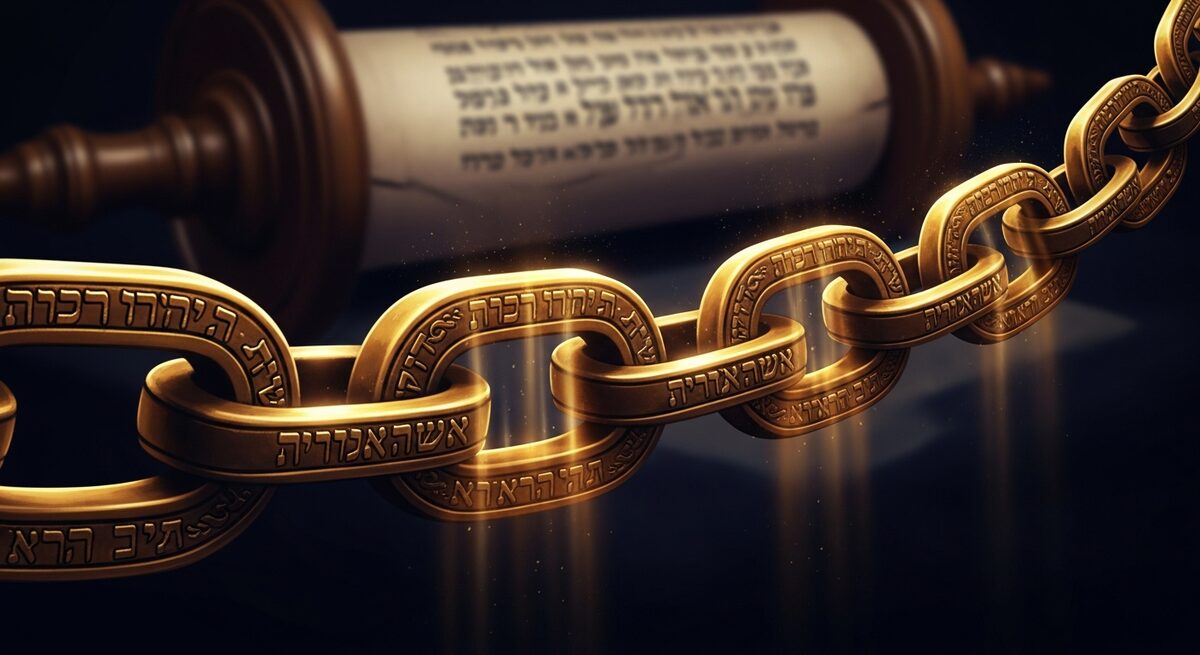
This post is Part Two of a three-part series. Read Part One: Fall Into Formation first, and continue to Part Three: The Center Holds.
Spiritual Order · Part Two
The military has always known something the church is still learning: you can't transmit values without structure. God knew this from the beginning. That's why He didn't just give Israel a message — He gave them a formation.
God's Full Spiritual Order — From the Book of Numbers
- Source — God
- Closest — Kohen Gadol (high priest)
- Priests — Kohanim
- Teachers — Levites
- Carriers — Israel
- Destination — The nations
Each bridge carries the signal one step closer to the world.
Every military commander knows you can't run an army by calling each soldier directly. The President of the United States sets the overall principles and vision — but the actual orders flow through generals, then colonels, then lieutenants, all the way down to the soldier on the ground. Without that chain, there is only chaos.
This is not a limitation of leadership. It is the architecture of effective transmission. Values don't jump across a room. They travel through people — through relationships, through trust, through faithful handoffs from one rank to the next.
The book of Numbers opens with exactly this architecture. A census. A camp formation. A detailed assignment of roles. Most readers want to skip ahead to the dramatic stories. But the Torah doesn't begin Numbers with stories. It begins with a formation. Because before God's people could move, they needed to understand how the signal traveled.
The Bridges God Built — Not Carriers, but Bridges
When God commands the Levites to carry the Mishkan, the immediate reaction is obvious: "Their fancy new job is to be the carrier?" But there is something far deeper happening.
God tells Moses: "I have taken the Levites from among the children of Israel in place of every firstborn Israelite." The Levites were appointed to fill the role of the bechor — the firstborn. And the firstborn has always had a specific spiritual function. In a family, the oldest child stands closest in age to the parents, positioned better than anyone to absorb the parents' values and model them for the younger children. The bechor is the bridge. The transmission point between the generations.
"Israel is my firstborn son."
Exodus 4:22
God called Israel His firstborn not as a term of favoritism, but as a term of commission. Israel was to be the bridge that carries God's values from their Source to the rest of humanity, His other children. But how do you build a bridge across that distance? God is infinite. The nations are scattered. The gap is enormous. So God built not one bridge, but a whole chain of them.
The Full Order Revealed: Six Links, One Chain
By the time Numbers unfolds the full spiritual architecture, six distinct layers of relationship have been established — each one bridging the gap between the one above and the one below:
The Innermost Bridge: The Kohen Gadol
Once a year, the high priest enters the Holy of Holies — the closest any human being comes to the direct presence of God. He carries the nation with him symbolically, then returns to transmit what he received.
The Daily Bridge: The Kohanim
The priests serve daily in the Mishkan — performing the sacrificial service, keeping the menorah lit, maintaining the showbread. They live so close to God that they become a distinct world, which is exactly why another bridge is still needed.
The People's Bridge: The Levites
They carry the Mishkan, serve the priests, and stand between the holy and the common. Moses blessed them: "You shall teach the laws to the people of Jacob, and the Torah to Israel." They are the relay point between the sanctuary and the street.
The World's Bridge: Israel
The whole nation — every tribe, every family, every individual counted in the census — is commissioned as "a kingdom of priests." Not because every Israelite serves in the Mishkan, but because every Israelite carries the values outward to the world.
And the chain doesn't end with Israel. It extends to the nations of the world — the ultimate recipients of the transmission that started at Sinai.
"The bridges are necessary to make sure that each person in the organization can effectively translate the principles and policies of the commander in chief."
Why the Levites — and Why It Matters: You Can Only Transmit What You Kept
The Levites weren't assigned their role arbitrarily. There was a moment that revealed who they were. When Moses came down from Sinai and found Israel worshipping the Golden Calf, he stood at the entrance of the camp and cried out: "Whoever is with God — come to me."
The entire nation had just broken faith. Chaos, fear, and compromise filled the camp. And in that moment, only one group stepped forward: all the sons of Levi.
This is the principle that cuts straight to the heart of transmission: only those who stay with God's values can transmit them. You cannot pass on what you have abandoned. You cannot be a bridge if you've collapsed.
The Levites earned their position not through birth order alone, but through faithfulness under pressure. They were chosen as the nation's teachers because when the moment of testing came, they stayed.
"You shall teach the laws to the people of Jacob, and the Torah to Israel."
Deuteronomy 33:10 — Moses' blessing to the Levites
The Formation Is for Everyone: You Are Not Farther From God — You Are Surrounding Him
Here is where the spiritual order becomes not just a structure but an act of love. When the camp formation in Numbers is explained, God doesn't place the Mishkan at the front with Israel trailing behind. Instead, every tribe surrounds the Mishkan on all sides. The divine presence is at the center, and the whole nation encircles it.
God is really saying: "Each of you counts. Everyone surrounds Me, not in a line behind the Mishkan, with some closer to Me and some farther from Me. Everyone resides around My presence, within their place in the spiritual order."
This is the message the census delivers to every ordinary Israelite: you are not a spectator. You are part of the formation. The farmer who grows the grain for the showbread. The artisan who presses oil for the menorah. The parent who teaches their children — every one of them is a link in the chain.
Without the people, there is no nation. Without the nation, there is no transmission. Without the transmission, the message never reaches the world.
Your Place in the Order: A Dual Destiny
Numbers closes its introduction with a charge that belongs to everyone: we have a dual destiny. We must support the Levite, honor the priest, and cling to God — but we also have a responsibility to model God's values and be a light unto the nations.
This is the genius of God's order. It is not a hierarchy designed to elevate some and diminish others. It is a system designed so that no one is left without a role, and no one's role is unimportant. Every link matters because the chain only holds if every link holds.
The Kohen Gadol's once-yearly encounter with God is extraordinary — but it means nothing if the priest doesn't serve, if the Levite doesn't teach, if Israel doesn't live it out, if the nations never see the light.
God is not looking for an elite few to carry His message while everyone else watches. He is looking for a kingdom of priests — an entire people, each in their place, each doing their part, each passing the signal to the next.
Find your place in the formation. Hold your position. Pass it forward.
The world is still waiting at the end of the chain.
Bamidbar — In the Wilderness, Together.
Continue the Series
- Part One: Fall Into Formation: God Has a Chain of Command
- Part Three: The Center Holds: God's Radial Kingdom and Where You Stand in It
The Torah insights in this post were inspired by teachings from AlephBeta — a remarkable resource for deep, meaningful exploration of the Torah. We encourage every reader to visit AlephBeta.org and experience their work firsthand.