Fall Into Formation: God Has a Chain of Command
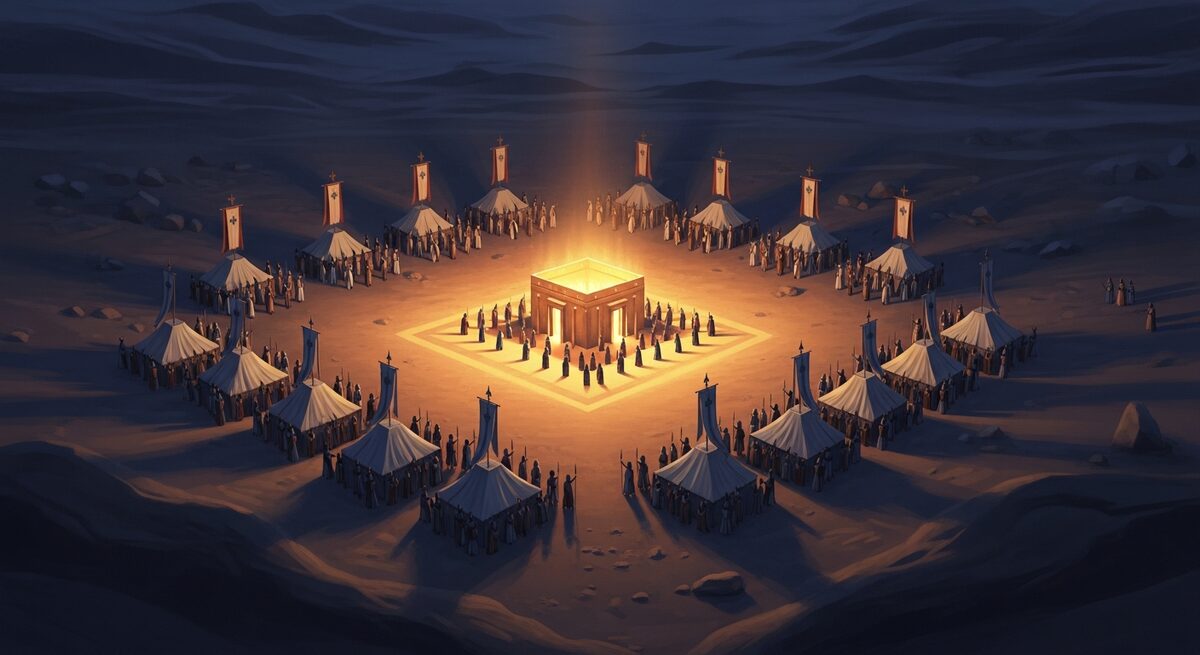
This post is Part One of a three-part series on the spiritual order God built into the wilderness camp. Continue with Part Two: Every Link in the Chain and Part Three: The Center Holds.
Torah & Order
The book of Numbers opens not with poetry or prophecy — but with a military census. There's a reason for that. God doesn't just have a message for the world. He has an order for delivering it.
God's Chain of Command — Numbers Chapter 3
- Commander — God
- Transmitter — Moshe
- Priests — Aharon & sons
- Carriers — The Jewish people
- Recipients — The world
Each link carries the signal one step closer to the world.
Every great military runs on order. There is a general, then officers, then sergeants, then soldiers — and every person in the chain knows their role. The mission doesn't move without that structure. Discipline isn't about limitation; it's about making sure the message gets through.
God, it turns out, operates the same way. And the book of Numbers — Bamidbar, meaning "in the wilderness" — opens with the most military-looking passage in all of Torah: a census, a counting of men by tribe, organized for formation, prepared to march. This was not an army gathering for conquest alone. It was an army organized to carry something holy.
The Structure of Transmission: The Order Was Always About the Message
Rabbi David Fohrman from Aleph Beta draws attention to a verse most readers skim right past — one of those genealogy sections people tend to doze through. The Torah declares:
"These are the generations of Aharon and Moshe on the day that God spoke with Moshe at Mount Sinai."
Numbers 3:1
The puzzle is immediate: the children listed are only Aharon's. Moshe's biological children aren't named at all. So why say "the generations of Aharon and Moshe"?
Rashi quotes a Midrash with a stunning answer: Aharon's children are called the generations of Moshe because Moshe taught them Torah. And the Midrash establishes a principle that echoes through all of Jewish thought — anyone who teaches another person's child Torah, the text considers it as if that teacher gave birth to them.
This is not a poetic metaphor. It is a statement about spiritual lineage. About how God's values travel through the world. Not just through bloodlines — but through transmission.
"Anyone who teaches someone else's child Torah — the text considers it as if the teacher gave birth to that child."
Israel as God's Carrier Force: A Chosen People Is a Commissioned People
The military parallel runs deeper than structure. In an army, being selected for a special unit is not a privilege of comfort — it is a commission of responsibility. Special forces don't get an easier assignment. They get a harder one, because they've been trusted to carry out what others cannot.
This is the vocation of the Jewish people in God's order. They were not chosen because they were the largest nation — the Torah itself says they were the smallest. They were chosen to be the carriers of His Torah to the world.
"You will be to me a kingdom of priests and a holy nation."
Exodus 19:6
A kingdom of priests. Not a kingdom that keeps holiness to itself — but one that mediates it outward, the way priests stand between the people and the altar. Every nation eventually had a priest in the Tabernacle system. Israel, as a whole, was to be that priest for humanity.
The census at the opening of Numbers counted fighting men — but the Levites were counted separately and assigned differently. Their job wasn't to fight. Their job was to carry the Mishkan — the portable dwelling of God's presence — through every camp, every march, every generation. They were the carriers of the signal.
Rank, Role & the Danger of Breaking Formation: Nadav and Avihu
God's order is not bureaucracy for its own sake. It exists because the mission is real, and the stakes are real. Fohrman's teaching makes this vivid through the tragic story of Nadav and Avihu — two of Aharon's sons who had so deeply absorbed Moshe's encounter with God at Sinai that they wanted to recreate it themselves.
Their names tell the story: Nadav means "volunteer." Avihu means "my father is he." They loved their teacher Moshe so profoundly that he had become like a father to them. And when the Mishkan was inaugurated — when God's presence descended again, just like it had at Sinai — they couldn't hold back. They rushed in. They brought their own fire.
"Nadav and Avihu died before God when they brought a foreign fire before God in the desert of Sinai."
Numbers 3:4
They weren't wicked. They were zealous beyond their commission. They stepped outside their place in the chain of command — not out of rebellion, but out of an overwhelming desire to be like Moshe. And that is exactly the warning embedded in this military structure: even the best intention, outside of proper order, can go wrong.
A soldier who charges without orders — even a brave, loyal soldier — can break the entire operation. God's order exists so that the transmission is clean, the roles are clear, and no one burns out running a mission they were not equipped to carry alone.
The Beauty of the System: God's Order Is How Love Travels
Here is what makes this so different from a human military structure: in God's chain of command, the purpose of every rank is to give, not to accumulate power. Moshe receives the Torah and immediately teaches it. Aharon and his sons receive and transmit it through the priestly service. The Levites carry the dwelling place so the whole nation can have access. The people live it out before a watching world.
Every level exists to pass something forward. The chain is not a hierarchy of status — it is a pipeline of blessing.
"I will make you into a great nation, and I will bless you… and all peoples on earth will be blessed through you."
Genesis 12:2–3
The promise to Abraham was never just about Abraham. It was about the world. God's order — tribe by tribe, priest by priest, teacher by student — is the mechanism by which that promise actually travels from one generation to the next, from one people to all peoples.
The genealogy sections aren't boring. They are the chain of command documented. Every name in those lists is a link in the transmission. Every parent who taught, every teacher who passed Torah on, every person who stayed in their role and did their part faithfully — they kept the signal alive.
God doesn't broadcast His message in chaos. He chose a people. He gave them structure. He commissioned them with His word. And He said: carry this. Teach it to your children. Let your children teach theirs.
The order is not a limitation on the mission. The order is how the mission survives.
Fall into formation. Know your role. The world is still waiting on what you're carrying.
Am Yisrael Chai.
Continue the Series
- Part Two: Every Link in the Chain: How God Built a Bridge to the World
- Part Three: The Center Holds: God's Radial Kingdom and Where You Stand in It
The Torah insights in this post were inspired by teachings from AlephBeta — a remarkable resource for deep, meaningful exploration of the Torah. We encourage every reader to visit AlephBeta.org and experience their work firsthand.