The Gift You Keep Missing Every Week (The Double Portion of Shabbat)
FAITH & PRACTICE
Shabbat isn't an obligation to fulfill — it's a door God opens for those who want more of Him.
What if one day each week, God made Himself unusually easy to find?
Not metaphorically — but as a literal, divine promise: that on this particular day, if you seek Him, you will receive a double portion of understanding. Not because you earned it. Not because you followed a rule. But because He set that day apart specifically for you to draw closer to Him.
That is Shabbat. And most of us are walking right past it.
What the Word Actually Says — It Begins with Separation
The Hebrew word Shabbat (שַׁבָּת) comes from a root meaning to rest, to cease, to stop. From the very first week of creation, God modeled something for us — He worked six days and set the seventh apart as something wholly different.
"By the seventh day God had finished the work he had been doing; so on the seventh day he rested from all his work. Then God blessed the seventh day and made it holy, because on it he rested from all the work of creating that he had done."
— Genesis 2:2–3
The rabbis describe Shabbat as the separation of the chol (common, ordinary) from the kadosh (holy, set-apart). Six days are common. One day is consecrated. The act of honoring Shabbat is the act of agreeing with God that this day is different — and living like it.
For someone who is Jewish, this has traditionally meant ceasing all labor — no buying, no selling, no creative work. For those who are not Jewish but who love God and want to walk closer to Him, the heart of Shabbat is still deeply available: stop your ordinary week. Step out of the grind. Create space for Him.
"Remember the Sabbath day by keeping it holy. Six days you shall labor and do all your work, but the seventh day is a sabbath to the LORD your God. On it you shall not do any work…"
— Exodus 20:8–10
The Hidden Promise — A Double Portion Is Waiting
Here is the part that changes everything — the part that moves Shabbat from a rule into a gift.
In the wilderness, when God provided manna, He gave the Israelites a specific instruction: on the sixth day, gather twice as much. The seventh day was set apart, and He made provision for it ahead of time.
"On the sixth day, they gathered twice as much — two omers for each person… Moses said to them, 'This is what the LORD commanded: Tomorrow is to be a day of sabbath rest, a holy sabbath to the LORD.'"
— Exodus 16:22–23
The double portion of manna is a picture — a living parable. God was showing His people: on the day I set apart, I provide more than enough. What is true for bread in the wilderness is true for spiritual understanding today. Those who honor Shabbat as a day of study, prayer, and seeking find that God opens something on that day that doesn't open as easily on other days.
The prophet Isaiah captures it plainly — and the promise attached to honoring this day is staggering:
"If you keep your feet from breaking the Sabbath and from doing as you please on my holy day, if you call the Sabbath a delight and the LORD's holy day honorable… then you will find your joy in the LORD, and I will cause you to ride in triumph on the heights of the land."
— Isaiah 58:13–14
The Real Stakes — Where You Leave This World Is Where You Begin the Next
There is a sobering idea woven through Scripture and through Jewish wisdom: the growth you experience in this life matters for eternity. We are not just passing through — we are being formed. Every week, every study, every moment of genuine seeking shapes who we are becoming.
Yeshua (Jesus) himself said:
"Store up for yourselves treasures in heaven, where moths and vermin do not destroy, and where thieves do not break in and steal. For where your treasure is, there your heart will be also."
— Matthew 6:20–21
Shabbat is one of the primary tools God gave us to build that treasure. It is a weekly invitation to grow — to understand Him more deeply, to study His word with focus and intention, to sit in His presence without the noise of the week pulling at you.
If you work straight through Shabbat and never pause to seek Him — you miss a double portion of what He had for you. Not because He punishes you. But because the door was open and you didn't walk through it.
How to Begin — Friday Night: The Table Is the Start
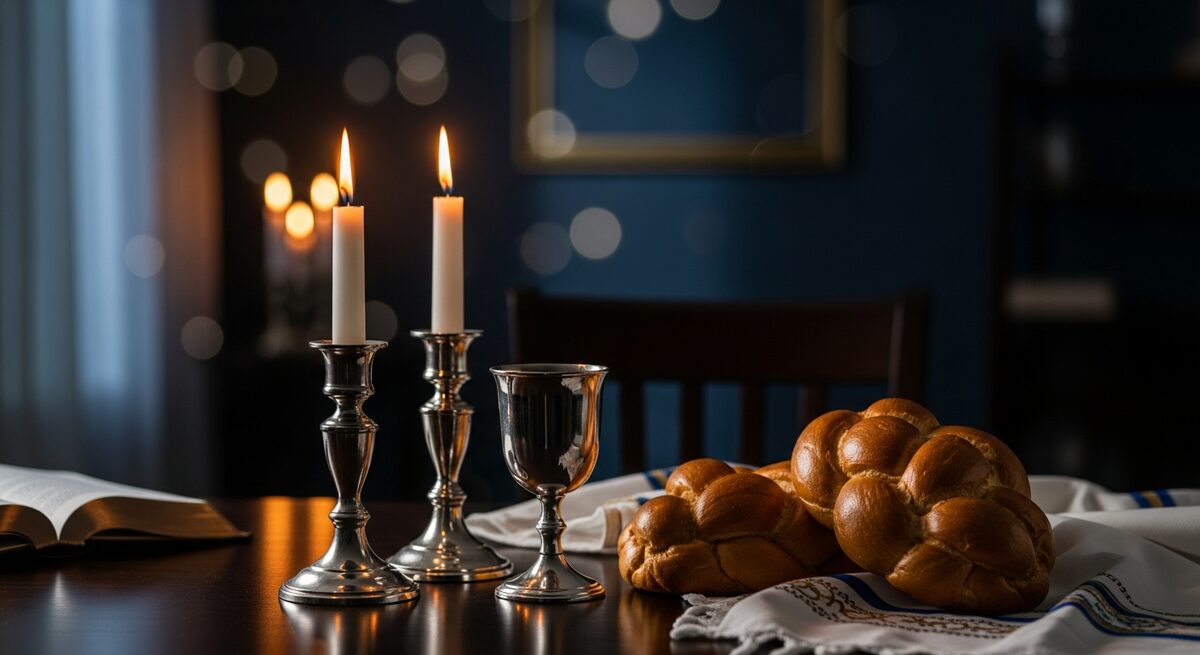
Shabbat begins at sundown on Friday. And one of the most beautiful ways to honor it — one practiced across thousands of years — is to gather for a Friday night meal. Light candles. Bless the bread and wine. Slow everything down. Acknowledge that something is different about this night.
This is not ritual for ritual's sake. It is an intentional act of separation. You are telling God — and yourself — that this time belongs to Him. That tonight and tomorrow, your attention is turned toward what lasts.
"These are my appointed festivals, the appointed festivals of the LORD, which you are to proclaim as sacred assemblies… There are six days when you may work, but the seventh day is a day of sabbath rest, a day of sacred assembly."
— Leviticus 23:2–3
Study His word on Shabbat. Pray. Rest from the noise. Let it be a day where you are genuinely available to Him — not scrolling, not working, not consuming — but seeking.
"Come to me, all you who are weary and burdened, and I will give you rest."
— Matthew 11:28
You are already doing life. You are already spending your weeks. The question Shabbat asks is simply this:
Will you set one day apart — not because you have to, but because you want to know Him more?
The promise is on the table. The door is open every Friday at sundown. The double portion is waiting for whoever comes hungry.
Shabbat Shalom
שַׁבָּת שָׁלוֹם
Related on This Site
- Should Christians Keep the Sabbath?
- The 10 Commandments (Sabbath as Commandment 4)
- What Is Teshuvah? (The Hebrew Word for Repentance)
- What Is Bereishit? (The First Word of the Torah)
- How Do I Repent? A Step-by-Step Guide
- The Importance of Prayer
Want to talk through what Shabbat could look like for your family? Ask our chat — it draws only from trusted Messianic teachers.