From Imperial Church to Medieval Christendom: How the Bishop of Rome Became a King
Church History Series · Part 4 (AD 337–800)
Part 3 ended with Constantine's death, by which point two centuries of theological drift and a generation of imperial law had already fused into something new: a church with the backing of the Roman state. But legal establishment was only the beginning. Over the next four and a half centuries, the question facing Christian leaders shifted from How do we survive Rome? to something far more complicated: How should we govern it?
This post covers that shift — from Theodosius making Christianity Rome's official religion, through Augustine's enormously influential theology of Jewish existence, through the collapse of the Western Empire itself, to the moment a pope placed a crown on a Frankish king's head and, without quite meaning to, created medieval Europe. It stops there, on Christmas Day, AD 800 — the hinge point where papal and imperial power fused into what historians call Latin Christendom. The centuries that followed — Crusade, Inquisition, Reformation — are stories for later posts.
Key Takeaways
- Theodosius' Edict of Thessalonica (380) made Nicene Christianity Rome's official religion, not merely a tolerated one — for the first time, the emperor himself defined orthodoxy and heresy.
- The Theodosian Code that followed left Judaism legal but no longer equal, restricting synagogue construction in some circumstances, Jewish public office, and outcomes tied to conversion in either direction.
- Augustine's “Witness Doctrine” (c. 400) argued Jews should be preserved, scattered, and never exterminated, since their continued existence testified to Scripture's truth — a position that protected many Jewish communities for centuries while simultaneously justifying their permanent legal subordination.
- The fall of the Western Roman Empire (476) didn't weaken the church — it strengthened the papacy, as the Bishop of Rome stepped into the civic vacuum left by the vanished imperial government.
- Gregory the Great (590–604) built the administrative machinery of medieval Catholicism and personally insisted Jews must not be murdered, robbed, or forcibly baptized — while also expecting their permanent social subordination, a tension that defined Catholic policy for centuries.
- The rise of Islam (632–750) stripped Christianity of Jerusalem, Antioch, and Alexandria within a single century, isolating Rome from Byzantine protection and pushing the papacy toward a new ally: the Franks.
- Pepin's donation of conquered Lombard territory to the Pope (756) transformed the papacy from a purely spiritual office into an actual territorial kingdom — setting the stage for Leo III to crown Charlemagne in 800.
A Quick Timeline
| Year | Milestone | Significance |
|---|---|---|
| 380 | Edict of Thessalonica | Nicene Christianity becomes Rome's official religion, not merely tolerated |
| c. 400 | Augustine's Witness Doctrine | Jews to be preserved but kept permanently subordinate |
| 476 | Western Rome falls | The papacy fills the political vacuum left by the vanished emperor |
| 590–604 | Gregory the Great's papacy | Medieval church administration takes shape; protective but restrictive Jewish policy |
| 632–711 | Islamic conquests | Jerusalem, Antioch, and Alexandria fall; Rome loses Byzantine protection |
| 756 | Donation of Pepin | The Pope becomes a territorial king with land, taxes, and armies |
| 800 | Leo III crowns Charlemagne | Papal and imperial power fuse into Latin Christendom |
Phase 1: Christianity Becomes the Law of the Land (380)
Constantine had legalized Christianity in 313. That's a different thing entirely from what Emperor Theodosius did in 380: the Edict of Thessalonica declared Nicene Christianity the official religion of the Roman Empire. Not one tolerated faith among several — the faith. For the first time in history, the emperor himself now determined orthodoxy, heresy, and the shape of public religious life. Being Roman increasingly meant being Christian.
The Theodosian Code, compiled over the following decades, translated that official status into accumulating legal restriction on Judaism: limits on building new synagogues in some circumstances, restrictions on Jewish public office, prohibitions on Jews owning Christian slaves, and escalating penalties tied to conversion between the two faiths. Judaism remained a legal religion under Roman law — but it was no longer an equal one. Rome had moved from persecuting Christians to privileging them, and everyone else's legal standing shifted accordingly.
Phase 2: Augustine and the Doctrine That Shaped a Thousand Years (c. 400)
If Paul shaped early Christian theology, Augustine of Hippo shaped Western Christianity more than anyone who came after him — and his thinking about the Jewish people would govern Catholic policy for roughly the next thousand years.
Augustine rejected the extermination of Jewish communities outright. Instead, he argued Jews should remain scattered throughout the nations, precisely because their continued existence — as a visibly distinct people, still holding the Hebrew Scriptures, still awaiting their own Messiah — served as a living witness to the truth of those Scriptures in the eyes of the church. This “Witness Doctrine” actually protected many Jewish communities from the kind of total destruction other conquered or dissenting groups sometimes faced under Rome and its successors.
But it was a double-edged inheritance. The same doctrine that argued for Jewish survival also supplied the theological justification for permanent legal inferiority. Jews should survive, in Augustine's framework — but they should never rule, never hold power, never occupy a position of authority over Christians. That principle became de facto medieval Catholic policy for centuries, producing exactly the mixture of protection and restriction that would characterize Jewish life in Christian Europe long after Augustine himself was gone.
As long as the earth remains, sowing and harvest, cold and heat, summer and winter, day and night, shall not cease.
— Genesis 8:22
It's worth noting the irony here: Augustine's doctrine of Jewish endurance echoes a biblical pattern of God preserving Israel that long predates him — yet the doctrine's medieval application spent that endurance on subordination rather than honor. The Scriptures promise Israel's continuation; they don't promise Israel's subjugation as the price of that continuation. That distinction matters for understanding where later church history went wrong.
Phase 3: Rome Falls, the Church Remains (476)
This may be the single largest turning point after Constantine himself. In 476, the Western Roman Empire collapsed. The emperor simply disappeared from the West. But one institution didn't vanish with it: the Church.
Almost overnight, the Bishop of Rome found himself functioning as judge, diplomat, relief organizer, negotiator, and civic leader — filling a vacuum the collapsed Roman government could no longer fill. There was no grand plan behind this. It was simply that when the machinery of imperial administration disappeared, the church was the only institution left standing with the organization, literacy, and continuity to hold anything together. Ironically, the fall of Rome made the papacy far more powerful than it had ever been under a functioning empire.
Phase 4: Gregory the Great Builds Medieval Catholicism (590–604)
If Constantine made Christianity legal, Gregory the Great made medieval Catholicism functional. He stands among history's great administrators, reorganizing missions, church governance, church finances, education, and relations with kings across Western Europe. He acted very much like a king himself — long before popes officially became kings in fact as well as function.
Gregory and the Jews
Gregory repeatedly insisted, in letters that survive to this day, that Jews should not be murdered, robbed, or forcibly baptized. His writings articulate the protective principle later summarized in the phrase Sicut Judaeis (“Thus concerning the Jews”) — though the actual papal bull carrying that title as a formal document belongs to the twelfth century, issued under Pope Calixtus II, not to Gregory's own era.
At the same time, Gregory also insisted Jews remain socially subordinate — protected from violence and coercion, but never equal participants in Christian society. Gregory embodies both halves of the medieval Catholic posture toward Jews: real, sometimes vigorously defended protection, alongside a rigid expectation of permanent subordination. That same tension would recur across the following centuries, softened by some popes and hardened by others, but never fully resolved.
Phase 5: Islam Reshapes the Map (632–750)
This chapter of the story often gets skipped in church-history overviews, and it shouldn't be. Within about a century of Muhammad's death, Islamic conquest had swept across Jerusalem, Antioch, and Alexandria — three of Christianity's oldest and most significant centers, along with vast Jewish and Christian populations across the Near East and North Africa.
This reshaped the entire geopolitical map facing Rome. The Byzantine emperor in Constantinople, once the natural protector of Italy and the Western church, could no longer reliably project power that far west while defending his own shrinking borders. The Pope needed a new defender — and found one not in the East, but among the Germanic kingdoms of Western Europe: the Franks.
Phase 6: Pepin and the Birth of Papal Territory (756)
This is the moment the papacy stops being a purely spiritual office and becomes an actual political one. Pepin the Short, king of the Franks, defeated the Lombards, who had been threatening Rome directly. Rather than returning the conquered territory to the Byzantine Empire — its nominal previous owner — Pepin gave it to the Pope.
This grant, remembered as the Donation of Pepin, made the Pope a territorial ruler in his own right: collecting taxes, maintaining armies, and negotiating treaties like any other medieval king. The office that had begun as a persecuted minority leadership role three centuries earlier now controlled land and wielded the machinery of state.
Phase 7: Christmas Day, 800
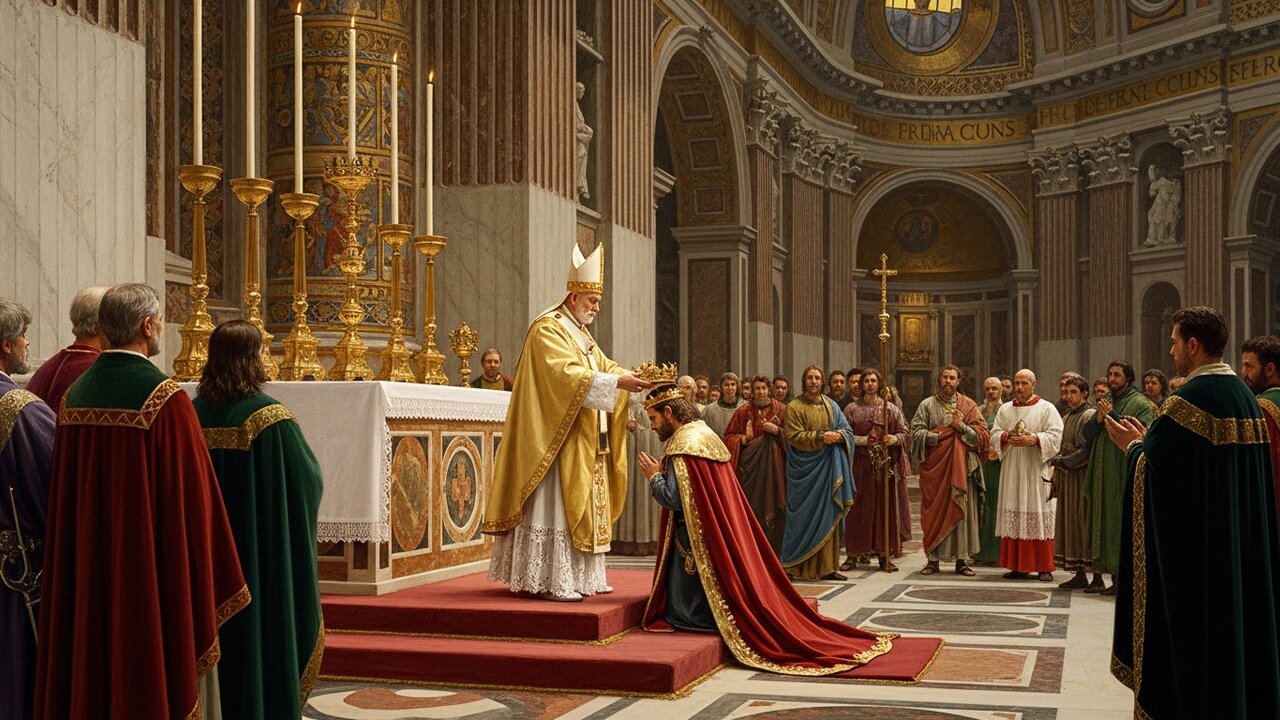
This may be the single most symbolically loaded moment in medieval history. On Christmas Day in the year 800, Pope Leo III crowned Charlemagne, King of the Franks, as Emperor — reviving, in the eyes of Western Europe, the title of Roman Emperor in the West for the first time since 476.
The order mattered enormously. The Pope crowned the emperor — not the other way around. That sequence carried unmistakable symbolism: spiritual authority appeared to bestow legitimacy on political authority, rather than the reverse. Charlemagne, in turn, offered protection and patronage to the Church. Each power now needed and legitimized the other.
This alliance created what historians call Latin Christendom — a civilization in which church and state were deeply intertwined, each drawing authority from the other, and often in real tension even while depending on one another. It is the point at which “the Church” and “Europe” stop being fully separable categories.
Why This Mattered for Jewish History
For the first time, the dominant religion, the dominant government, and the dominant culture of an entire civilization had become genuinely intertwined. A Jew living in early medieval Europe was no longer simply a religious minority inside a religiously plural empire, as had still been technically true under pagan Rome. He lived inside a civilization whose laws, education, calendar, courts, and public life were now all shaped by a single faith — one that, per Augustine, expected his community's survival but never its equality.
It's worth resisting the temptation to flatten this into a single uniform story. Some kings protected Jewish communities; others expelled them. Some popes actively defended Jews against mob violence and forced baptism, standing on Gregory's and Augustine's protective principles; others imposed severe new restrictions. The experience varied considerably across regions and centuries — medieval Jewish life was not one continuous, unbroken experience of persecution, nor was it one of simple tolerance. It was administered, unevenly, inside a civilization that had fused throne and altar at the very moment this post ends.
For the gifts and the calling of God are irrevocable.
— Romans 11:29
Frequently Asked Questions
What's the difference between Constantine legalizing Christianity and Theodosius making it official?
Constantine's Edict of Milan (313) made Christianity legal alongside other religions in the empire. Theodosius' Edict of Thessalonica (380) went further, declaring Nicene Christianity the empire's official religion and giving the emperor authority to define orthodoxy and heresy. The first was toleration; the second was establishment.
What was Augustine's Witness Doctrine, and how did it shape medieval Jewish life?
Augustine argued that Jews should never be exterminated but should remain scattered among the nations, since their continued existence testified to the truth of Scripture. This protected many Jewish communities from destruction for centuries, but it also supplied theological justification for their permanent legal and social subordination — a combination that shaped Catholic policy toward Jews for roughly a thousand years.
Why did the fall of Rome in 476 strengthen the papacy rather than weaken the church?
When the Western Roman imperial government collapsed, no other institution had the organization, literacy, or continuity to fill the resulting vacuum in civic life. The Bishop of Rome stepped into roles like judge, diplomat, and relief organizer almost by default, which gave the papacy far more practical authority than it had held under a functioning empire.
Did Gregory the Great protect Jewish communities?
Yes, in specific and documented ways — his letters insist Jews must not be murdered, robbed, or forcibly baptized, articulating principles later associated with the phrase Sicut Judaeis. At the same time, he also expected Jews to remain socially subordinate, so his legacy combines genuine protection with insistence on permanent inferior status.
How did the rise of Islam affect the Western Church's relationship with Byzantium?
Islamic conquests between roughly 632 and 750 took Jerusalem, Antioch, and Alexandria, three of Christianity's most significant ancient centers, and destabilized Byzantine power across the Mediterranean. This left the Byzantine emperor unable to reliably protect Italy and the West, pushing the papacy to seek a new protector among the Frankish kings.
What was the Donation of Pepin, and why does it matter?
In 756, Pepin the Short gave the Pope territory won from the defeated Lombards rather than returning it to Byzantium. This transformed the papacy from a purely spiritual office into an actual territorial kingdom with taxes, armies, and treaties — laying the groundwork for the political alliance formalized at Charlemagne's coronation in 800.
Why is Charlemagne's coronation considered such a pivotal moment?
When Pope Leo III crowned Charlemagne as emperor on Christmas Day, 800, the order of events — the Pope bestowing the crown, not receiving it — symbolically established spiritual authority as the source of political legitimacy in the West. This alliance between papal and imperial power created what historians call Latin Christendom, a civilization in which church and state were deeply, if sometimes uneasily, intertwined.
Looking Ahead
By the time Leo III placed a crown on Charlemagne's head, the dominant religion, government, and culture of Western Europe had fused into a single civilization — one Jewish communities would now have to navigate as a permanent minority inside a Christian social order, rather than as one religious group among many inside a pluralistic empire. The centuries that followed would test every part of the uneasy Augustinian settlement: protection and subordination, toleration and expulsion, coexistence and violence. The Crusades, the Inquisition, and the Reformation all still lie ahead in this series — each one, in its own way, a working-out of the tensions this post has traced from Theodosius to Charlemagne.
Continue the Journey
This is Part 4 of a series tracing how the church separated from its Jewish roots and became the civilization of Europe. Part 1 covers Roman persecution from Augustus through Domitian; Part 2 covers the theological separation between church and synagogue; Part 3 covers how Constantine institutionalized that separation as imperial law. You may also want to explore related posts on the site, including Fall Into Formation, Every Link in the Chain, and The Center Holds, which trace these same threads of Scripture and history across the whole of God's unfolding story.