What Abraham Knew About Micah 6:8
Micah 6:8 sums up what God requires in three short phrases. More than a thousand years earlier, Abraham had already lived every one of them.
A Verse Abraham Had Already Lived
“He hath shewed thee, O man, what is good; and what doth the LORD require of thee, but to do justly, and to love mercy, and to walk humbly with thy God?”
Micah 6:8
Micah 6:8 is one of the most quoted verses in Scripture. It is usually read as a fresh moral summary: three simple requirements, stated plainly.
But Micah was not inventing a new ethic. He was pointing Israel back to a life that had already been lived, more than a thousand years before him, by the man the New Testament calls “the father of us all” (Romans 4:16). Read Abraham’s story in Genesis with Micah 6:8 in hand, and the three requirements stop being abstractions. They become a portrait.
To Do Justly
The Hebrew word behind “justly” is mishpat. It is the same word God uses when He explains why He chose Abraham in the first place:
“For I know him, that he will command his children and his household after him, and they shall keep the way of the LORD, to do justice and judgment.”
Genesis 18:19
Micah’s first requirement is the very thing Abraham was called to practice and pass down. And Genesis shows him doing it.
He was honest in business. When Ephron the Hittite offered him a burial cave for free, Abraham insisted on paying the full price. He weighed out four hundred shekels of silver in public, before witnesses at the city gate (Genesis 23:13–16). When the king of Sodom offered him the spoils of war, he refused to take so much as a thread or a sandal strap, so no one could say a pagan king had made him rich (Genesis 14:22–23).
He settled disputes openly. When Abimelech’s servants seized his well, Abraham did not seize it back. He raised the matter, then gave seven ewe lambs as a public witness that the well was his (Genesis 21:25–30).
He trained his children in justice. Genesis 18:19 is itself a statement about parenting. Abraham’s justice was not a private virtue; it was a household inheritance.
Most striking of all, Abraham appealed to God’s own justice. Pleading for Sodom, he asked, “Shall not the Judge of all the earth do right?” (Genesis 18:25). The word translated “right” is mishpat. Abraham knew that justice was not his idea. It was God’s character, and he expected God to act like Himself.
To Love Mercy
The second word is chesed: loving kindness, covenant loyalty, goodness that goes beyond what is owed. Micah himself ties this word to Abraham. His book closes with the promise, “Thou wilt perform the truth to Jacob, and the mercy to Abraham” (Micah 7:20). That “mercy” is chesed. Later Jewish tradition would go on to remember Abraham as the man of loving kindness, but the connection starts in the prophet’s own text.
Most of Abraham’s recorded life falls under this one clause.
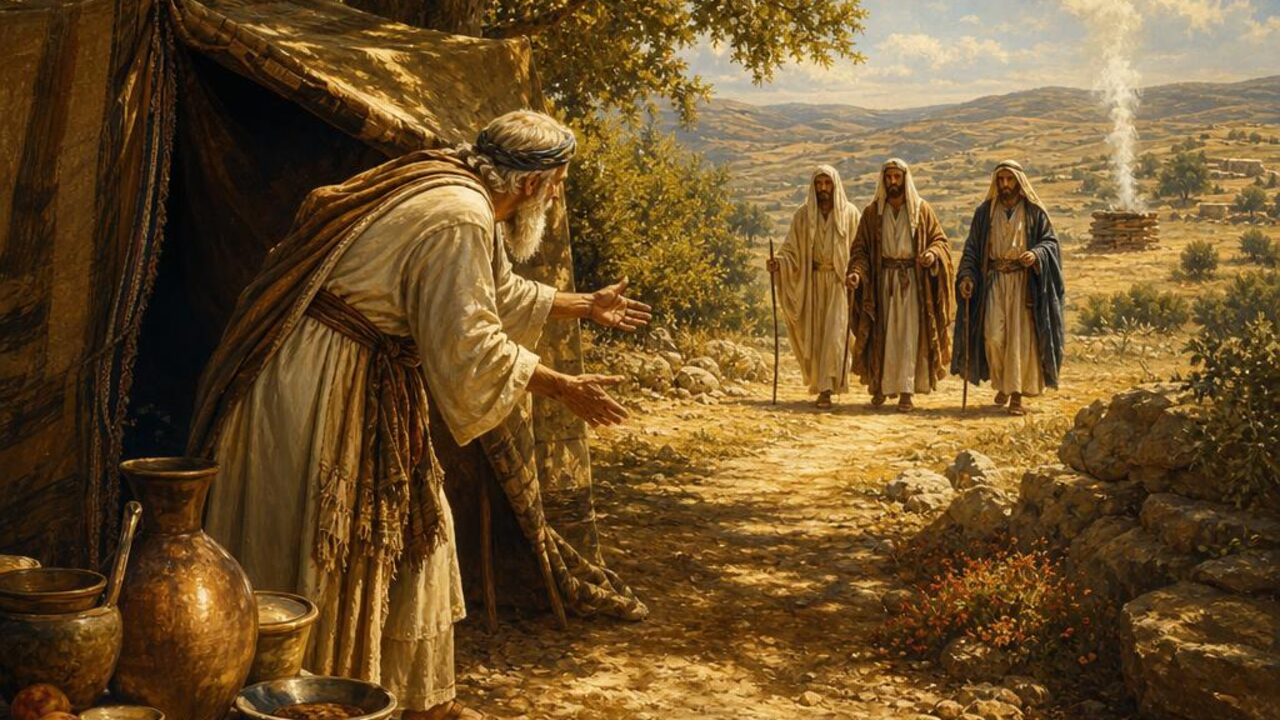
- Hospitality to strangers. Sitting at his tent door in the heat of the day, he ran to meet three travelers, bowed, and served them a meal (Genesis 18:1–8). Hebrews 13:2 points back to this scene.
- Devotion to his kinsmen. He took Lot with him from Haran (Genesis 12:4–5), and when Lot was carried off as a captive, Abraham armed 318 men and brought him back (Genesis 14:14–16).
- Kindness to his neighbors. That same rescue recovered the people and goods of Sodom. Years later, Abimelech appealed to the kindness Abraham had already shown him (Genesis 21:23).
- Loyalty to his wife. When Sarah died, Abraham came to mourn and to weep for her (Genesis 23:2), then bought a permanent resting place for her.
- Reverence for the dead. The whole of Genesis 23 is given to that purchase. Burying the dead is kindness that can never be repaid, which makes it a pure form of chesed.
- Forgiving and reconciling. After Abimelech wronged him, Abraham did not hold a grudge. He made a covenant with him (Genesis 21:27).
- Praying for those who wronged him. Abimelech had taken Sarah into his house. Abraham prayed for him anyway, and God healed Abimelech’s household (Genesis 20:17).
- Interceding for the wicked. He bargained with God for Sodom, from fifty righteous people down to ten (Genesis 18:23–33).
Notice that Micah does not say merely “do mercy.” He says love it. Abraham fits the wording. Genesis 18 is full of hurry: he ran, he hastened, he told Sarah to make ready quickly. Mercy was not a duty he discharged. It was something he was eager to do.
An honest reading also admits that Abraham was not flawless here. Twice he passed Sarah off as his sister to protect himself (Genesis 12:11–13; 20:2). Scripture does not hide this, and neither should we. Abraham’s chesed was real, but it was the chesed of a man still being formed by God.
To Walk Humbly With Thy God
God’s charge to Abraham was a charge about walking: “I am the Almighty God; walk before me, and be thou perfect” (Genesis 17:1). Near the end of his life, Abraham described God the same way: “The LORD, before whom I walk” (Genesis 24:40). His whole life was a journey taken in God’s presence, starting with a departure when he did not know where he was going (Hebrews 11:8).
The Hebrew phrase Micah uses, hatznea lekhet, suggests a modest, quiet walk, not a showy one. Abraham’s humility shows up in three ways.
Humility before people. He bowed to his visitors (Genesis 18:2) and bowed again before the Hittites when he negotiated for Sarah’s grave (Genesis 23:7, 12). This was a man God had promised to make a great nation, and he still treated ordinary people with honor.
Deference to others. When his herdsmen and Lot’s began to quarrel, Abraham, the elder and the one who held the promise, gave Lot first choice of the land (Genesis 13:8–9). He trusted God to keep His word without grabbing for himself.
Humility before God. Even while pleading boldly for Sodom, he remembered who he was: “I have taken upon me to speak unto the Lord, which am but dust and ashes” (Genesis 18:27). Boldness and humility were not opposites for Abraham. He could argue with God precisely because he knew he stood before Him as a creature.
This walk also shaped his worship. Everywhere he went, he built an altar and called on the name of the LORD (Genesis 12:7–8; 13:18; 21:33). He gave a tenth to Melchizedek (Genesis 14:20). God’s interests came first, and Abraham never made himself the center of the story.
The Question Behind the Verse
Micah 6:8 is an answer, and it helps to hear the question. In the verses just before, the prophet voices a worshiper asking what would finally satisfy God:
“Wherewith shall I come before the LORD, and bow myself before the high God? shall I come before him with burnt offerings, with calves of a year old? Will the LORD be pleased with thousands of rams, or with ten thousands of rivers of oil? shall I give my firstborn for my transgression, the fruit of my body for the sin of my soul?”
Micah 6:6–7
That last question should stop any reader of Genesis. It sounds like Mount Moriah.
In Genesis 22, Abraham was asked for his son and did not withhold him. But the story does not end with a sacrifice of a child. God stopped Abraham’s hand and provided a ram in Isaac’s place (Genesis 22:12–13). Abraham named the place “The LORD will provide” (Genesis 22:14).
Micah’s answer carries the same lesson. God does not want our firstborn. He has already shown what He wants, and it is not a bigger offering. It is a life of justice, loving kindness, and humble walking with Him. Moriah proved Abraham would hold nothing back from God; the rest of Genesis shows what a life held out to God looks like day by day.
Faith That Walks
It would be easy to read all of this as a checklist: be just, be kind, be humble, and God will accept you. The New Testament will not let us read Abraham that way.
Paul is clear that Abraham’s standing with God began with trust, not performance. “Abraham believed God, and it was counted unto him for righteousness” (Romans 4:3). He “staggered not at the promise of God through unbelief; but was strong in faith, giving glory to God” (Romans 4:20). Hebrews 11 tells the same story: by faith he left home, by faith he lived in tents, by faith he offered Isaac, trusting that God could raise him from the dead (Hebrews 11:8–19).
James looks at the same man from the other side. “Seest thou how faith wrought with his works, and by works was faith made perfect?” (James 2:22). Then James adds the title that sums up Abraham’s life: “he was called the Friend of God” (James 2:23).
Paul and James are not in conflict. Paul describes the root; James describes the fruit. Abraham’s justice, mercy, and humility did not earn God’s friendship. They were what that friendship looked like when it was lived out in tents, at wells, and at gravesides.
Jesus made the same point to people who claimed Abraham as their father: “If ye were Abraham’s children, ye would do the works of Abraham” (John 8:39). Descent is not enough. Abraham’s true children are those who share his faith and walk the way he walked.
Walking in His Steps
Paul says we are to “walk in the steps of that faith of our father Abraham” (Romans 4:12). Micah 6:8 tells us what those steps look like. They are rarely dramatic.
- Do justly: pay what you owe, keep your word in business, and settle disputes in the open.
- Love mercy: open your door to strangers, stand by your family, honor the dead, forgive quickly, and pray for the people who have wronged you.
- Walk humbly: let others choose first, treat ordinary people with honor, and never forget that you are dust and ashes standing before a holy God.
Abraham did not get every step right. But he kept walking, and God called him His friend. The same invitation stands open to us. “He hath shewed thee, O man, what is good.” The only question left is whether we will walk in it.
Keep Exploring
Abraham's story runs all through this site. A few places to keep going:
- A Message of Hope for Parents — Abraham, Lot's family, and the intercession of Genesis 18.
- According to Your Faith: How Repentance Opens Your Eyes to God's Ways
- What Is Repentance in the Bible?
- What Is Teshuvah? The Hebrew Meaning of Repentance
- The 30-Day Repentance Journey — one step at a time, walking in the steps of that faith.
Frequently Asked Questions
What does Micah 6:8 mean?
Micah 6:8 says that what God requires is not more sacrifices but a changed life: to do justly, to love mercy, and to walk humbly with God. The prophet was answering people who thought they could please God with offerings while ignoring how they treated others. The verse summarizes biblical faith in three parts: justice toward people, loving kindness from the heart, and humility before God.
How does Abraham relate to Micah 6:8?
Abraham’s life in Genesis is a living example of Micah 6:8. He did justly by dealing honestly in business (Genesis 23:13–16) and teaching his household “to do justice and judgment” (Genesis 18:19). He loved mercy through hospitality, forgiveness, and intercession (Genesis 18; 20; 21). He walked humbly before God, calling himself “but dust and ashes” (Genesis 18:27). Micah himself links God’s mercy to Abraham in Micah 7:20.
What does “do justly” mean in Hebrew?
The word translated “justly” in Micah 6:8 is mishpat, meaning justice, right judgment, or doing what is right. It is the same word used in Genesis 18:19, where God says Abraham will teach his children “to do justice and judgment,” and in Genesis 18:25, where Abraham asks, “Shall not the Judge of all the earth do right?”
What does “love mercy” mean in Micah 6:8?
The Hebrew word for “mercy” is chesed, often translated loving kindness, steadfast love, or covenant loyalty. It describes goodness that goes beyond what is owed. Micah says to love mercy, not just to show it, meaning kindness should be a desire of the heart rather than a reluctant duty.
What does it mean to walk humbly with God?
To walk humbly with God means living every day in God’s presence with a modest, teachable heart. The Hebrew phrase suggests a quiet walk rather than a showy one. God gave Abraham the same charge: “walk before me, and be thou perfect” (Genesis 17:1).
Why is Abraham called the friend of God?
James 2:23 says Abraham “was called the Friend of God” because he believed God and his faith showed itself in obedience. The title also appears in 2 Chronicles 20:7 and Isaiah 41:8. Abraham trusted God’s promises, followed Him without knowing where he was going, and did not withhold his son Isaac.
How does Micah 6:7 connect to Abraham and Isaac?
Micah 6:7 asks, “shall I give my firstborn for my transgression?” That question echoes Genesis 22, where God tested Abraham by asking for Isaac. God stopped Abraham and provided a ram instead. Micah’s answer in 6:8 carries the same lesson: God does not want our children as offerings. He wants justice, mercy, and humility.
Do Paul and James contradict each other about Abraham?
No. Romans 4 teaches that Abraham was counted righteous because he believed God. James 2 teaches that real faith shows itself in action, pointing to Abraham’s obedience at Moriah. Paul describes the root of Abraham’s righteousness, and James describes its fruit. Both quote the same verse, Genesis 15:6.
What are examples of Abraham’s kindness in the Bible?
Abraham welcomed three strangers and served them a meal (Genesis 18:1–8), rescued his nephew Lot from captivity (Genesis 14:14–16), prayed for Abimelech after Abimelech took Sarah (Genesis 20:17), interceded for Sodom (Genesis 18:23–33), and honored Sarah with a permanent burial place (Genesis 23).
How can Christians follow Abraham’s example today?
Romans 4:12 calls believers to “walk in the steps of that faith of our father Abraham.” In practice, that means being honest in work and money, welcoming strangers, forgiving quickly, praying for people who wrong us, letting others go first, and trusting God’s promises. Jesus said, “If ye were Abraham’s children, ye would do the works of Abraham” (John 8:39).