The Center Holds: God's Radial Kingdom and Where You Stand in It
This post is Part Three of a three-part series. Read Part One: Fall Into Formation and Part Two: Every Link in the Chain first.
Spiritual Order · Part Three
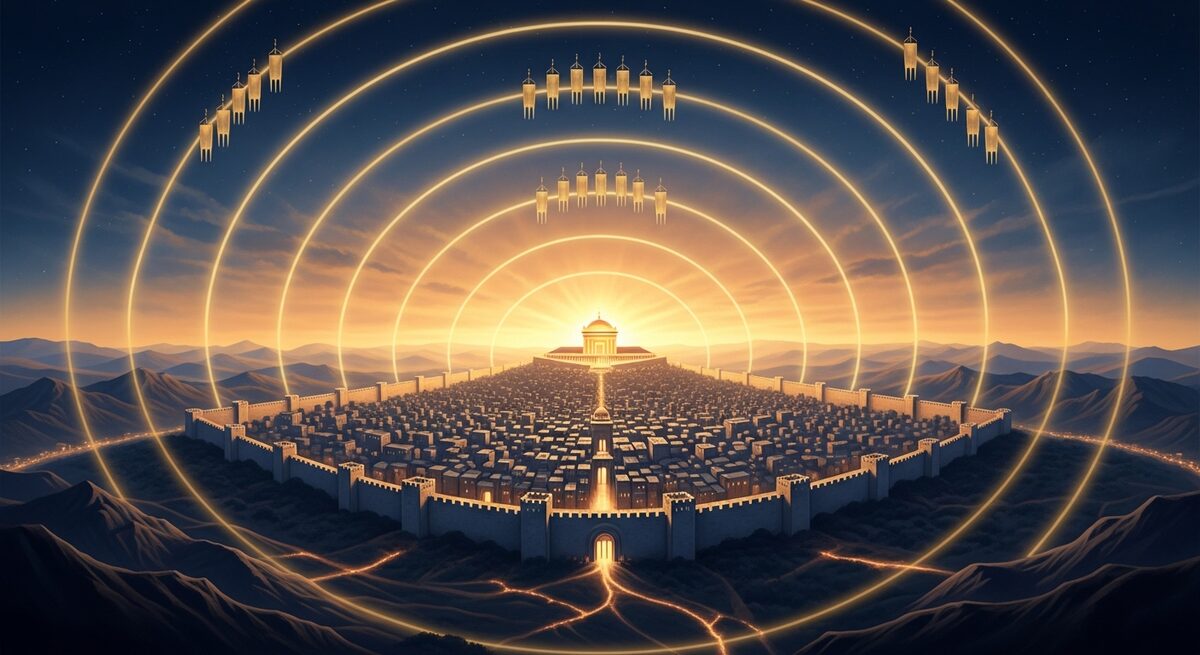
The wilderness camp wasn't just logistics. It was a picture of the future. Messiah at the center. Priests around Him. Israel around them. Nations around Israel. The whole world, ordered around one point — and every ring has a role.
This Post Is Part of a Series
- Part One: Fall Into Formation: God Has a Chain of Command
- Part Two: Every Link in the Chain: How God Built a Bridge to the World
- Part Three ★ (you are here): The Center Holds: God's Radial Kingdom and Where You Stand
In the first two posts in this series, we followed the chain of command from God through Moshe, through the priesthood, through the Levites, through Israel, to the nations. But in this week's Torah portion — Bamidbar, Numbers 1–4 — something remarkable comes into view. The chain we traced isn't really a chain at all.
It's a circle. It has always been a circle. And Zion is at the center.
The Wilderness Formation: Three Tribes on Every Side
When God commanded Moses to arrange the camp in the wilderness, He didn't line the tribes up in a row or sort them by seniority. He placed the Tabernacle — the Mishkan, the dwelling place of His presence — at the absolute center. Then He arranged the twelve tribes in four groups of three, surrounding it on every side.
"The sons of Israel shall camp, each by his own standard, with the banners of their fathers' households; they shall camp around the tent of meeting at a distance."
Numbers 2:2
Nobody was behind the Mishkan. Nobody was farther from God than anyone else. Everyone surrounded the presence. The Levites formed an inner ring directly around the Tabernacle. And at the very center of the Levitical camp, the priests camped directly before the entrance of the Tabernacle itself.
This wasn't merely a camping arrangement. It was a diagram of the kingdom.
Radial Ecclesiology — Numbers 2 → Ezekiel 48 → The Kingdom
- Outermost ring — The Nations: recipients of the blessing
- Israel: kingdom of priests · bechor to the world
- Priests & Levites: daily service · teachers · buffer of holiness
- Kohen Gadol: once a year · Holy of Holies
- Innermost — Messiah / Zion: the center of all things
From the Wilderness to the Kingdom: Ezekiel Saw the Same Picture
Fast-forward from the wilderness to the prophet Ezekiel's vision of the Messianic Era. When God shows Ezekiel the restored land of Israel in the last days, He doesn't hand each tribe back its original Joshua-era territory. He completely rearranges everything around a single, non-negotiable fixed point: a sacred district at the center of the land, where the Temple stands.
The tribes are arranged in parallel horizontal bands — six tribes to the north of the holy district, six tribes to the south. At the very heart of the land lies what Ezekiel calls the terumah — the holy allotment — a roughly nine-mile-deep east-west corridor centered on Jerusalem, with the Temple and the priesthood positioned precisely in the middle.
"The holy allotment and the sanctuary of the house shall be in the middle of it."
Ezekiel 48:21
Flanking the holy district on east and west is territory reserved for the Prince — the Messiah — stretching from the Mediterranean Sea to the Jordan River. The pathways to Zion belong to Him. The river of life flows from the Temple through His portion, transforming the land into a new garden of Eden.
What Ezekiel is drawing is not a real-estate map. It is a theological statement: in the kingdom, everything is arranged outward from the presence of God. The same logic that organized the wilderness camp governs the entire restored land. And the land in turn governs the entire world.
Radial Ecclesiology: The Structure of the Kingdom — Now and Forever
First Fruits of Zion's Torah Club calls this "Radial Ecclesiology" — the study of how the community of the Messiah is ordered. The word radial means radiating outward from a center. The word ecclesiology means the structure of the community of God.
Put them together and you get this: the people of God are not a hierarchy where some are more important than others. They are a series of concentric rings, each one radiating the glory of the center outward to the next.
In the Messianic Era: the tribe of Levi organizes around the Messiah in Zion. The other tribes of Israel organize around the Levites. The nations organize around Israel. The Levites stand before God on behalf of Israel, and before Israel on behalf of God. Israel mediates between the Levites and the nations. The nations receive the blessing at the outermost ring — and then pass it even further.
But here is the stunning part — this structure isn't only future. The earliest communities of Yeshua understood themselves as a prolepsis of this kingdom: a present-day anticipation of what is coming. They organized themselves with the Messiah at the center, Israel around Him, and the nations gathering around Israel. Not replacing Israel. Organizing around Israel. Receiving the blessing through Israel.
"This is Jerusalem; I have set her at the center of the nations, with lands around her."
Ezekiel 5:5
Mountains Low, Valleys High: The Kingdom Requires an Inversion First
Before Zion can rise as the center of the world, Isaiah says the terrain must be transformed: every valley lifted up, every mountain made low. The rough ground must become a plain.
"Let every valley be lifted up, and every mountain and hill be made low; and let the rough ground become a plain, and the rugged terrain a broad valley."
Isaiah 40:4
This is partly literal — the land of Judah will be leveled into a plain, and Jerusalem will rise above it. But it is also a moral statement. In Hebrew idiom, to move a mountain is to remove an obstacle. The kingdom cannot come while human pride, corrupt power structures, and false hierarchies remain standing. The high must be brought low. The lowly must be lifted up.
Yeshua said exactly this in the Sermon on the Mount: the meek inherit the earth, the mourners are comforted, the poor in spirit receive the kingdom. The last shall be first. Whoever would be great must become a servant. The inversion of the world's order is not a side effect of the kingdom — it is the arrival of the kingdom.
And when those false mountains are leveled, Zion can be seen from everywhere. A city on a hill cannot be hidden. The mountain of the Lord's house will be established as the chief of all mountains — not because it fought its way to the top, but because everything around it was finally brought to its proper height.
The Twelve Gates: Every Tribe Has a Gate. Every Person Has a Way In.
Ezekiel's vision of Messianic Jerusalem ends with a detail so precise it staggers the imagination: the rebuilt city has twelve gates in its walls, three on each side, each one named for one of the twelve tribes. When the tribes ascend to Jerusalem for the feasts, each one enters through its own gate.
Nobody is turned away at the door. Nobody has to enter through someone else's gate. Every tribe — every family — has its own designated way into the presence of God.
"The name of the city from that day shall be, 'The LORD is there.'"
Ezekiel 48:35
Revelation picks up this same vision and expands it: twelve gates, the names of the twelve tribes written on them, angels standing at each gate. And now the nations stream through those gates as well, bringing their glory and honor into the city. The whole world, organized around the center. Every gate open. Every people welcomed through the particular path God prepared for them.
The order was always heading here. From the wilderness camp to the Messianic city, the structure never changed. Presence at the center. Rings of holiness radiating outward. Every gate named. Every people included. Every role essential.
We are living between the wilderness camp and the Messianic city. The structure of the kingdom has been revealed. The center point has been established — Yeshua, the Messiah, the glory of the LORD, already revealed and already reigning.
The call now is to find your ring and fill it. Know your gate. Walk your path toward the center. And as you do, carry what you receive outward to the ring beyond you.
The center holds. The gates are open. The nations are still coming.
"The LORD is there." — Ezekiel 48:35
The Torah insights in this post were inspired by teachings from AlephBeta and from First Fruits of Zion (FFOZ) and their Torah Club study series — a remarkable Messianic Jewish resource for disciples who want to understand the Scriptures in their full Jewish context. We encourage every reader to visit ffoz.org and explore their work, including Torah Club, HaYesod, and their many free resources.