Caesar or Christ: How Persecution Evolved from Augustus to Domitian
The Relationship Between Israel, the Church, and Political Power · Part 1
About This Series
This is the first post in an eight-part series tracing one long story: the relationship between Israel, the Church, and political power — from Rome's earliest persecutions of believers in Yeshua to the present day, and to what Scripture says lies ahead. Across two thousand years, the series follows how a movement that began as Torah-observant Jews proclaiming Israel's Messiah was pulled apart from the synagogue, absorbed into empire, weaponized against the Jewish people — and how, in our own generation, that long trajectory has begun to reverse.
- Part 1 — Caesar or Christ: How Persecution Evolved from Augustus to Domitian (this post)
- Part 2 — The Great Separation: How Church Fathers and Rabbis Pulled Two Communities Apart
- Part 3 — When Theology Became Law: How Constantine Institutionalized the Church's Separation from Judaism
- Part 4 — From Imperial Church to Medieval Christendom: How the Bishop of Rome Became a King
- Part 5 — Christendom Tested: Crusade, Persecution, and the Road to the Inquisition
- Part 6 — From Exile to Restoration: The Return of Israel
- Part 7 — Israel Restored: War, Peace, and the Rediscovery of Jewish Roots
- Part 8 — Redemption Unfolding: Rising Hatred, Rising Return, and the Hope of Zechariah 14
The Book of Revelation didn't fall out of the sky, detached from history. It was written to real congregations, living under a real empire, at a real moment when the cost of confessing "Jesus is Lord" had never been higher. If you read the Gospels, Acts, Paul's letters, and Revelation against the backdrop of the Roman emperors who reigned across that century, you can watch the relationship between Rome and the followers of Yeshua shift — from a peace that made the Gospel's spread possible, to an empire-wide demand for loyalty that made confessing Him a capital offense.
Understanding this history doesn't just satisfy curiosity about the ancient world — it changes how you read Revelation, and it clarifies exactly what question the early believers were being asked to answer with their lives.
Key Takeaways
- Persecution of believers in Yeshua didn't appear overnight. It developed across eight emperors, moving from official indifference to organized ideological pressure.
- Under Augustus and Tiberius, Rome barely distinguished the earliest believers from Jews generally — and the opposition Jesus faced came mostly from certain Jewish leaders, not from Rome itself.
- Nero's persecution after the Great Fire of Rome (AD 64) marked the first time Rome treated "Christians" as their own identifiable, targeted group.
- The fall of Jerusalem under Titus (AD 70) reshaped both Judaism and the young Messianic movement, forcing a visible separation that hadn't existed before.
- Domitian turned the Jewish tax (the Fiscus Judaicus) into a tool for investigating who was loyal to Israel's God rather than to Caesar — the backdrop for John's exile and the writing of Revelation.
- The question running underneath all of it was never really "Are you Jewish?" It was "Who is your Lord?" — and that is still the question Revelation puts to every reader.
A Timeline: Rome and the Early Believers
Here is how eight emperors line up against the New Testament story.
| Emperor | Reign | New Testament Events | Effect on Believers |
|---|---|---|---|
| Augustus | 27 BC – AD 14 | Birth of Jesus | Relative peace (Pax Romana) |
| Tiberius | AD 14–37 | Ministry, crucifixion, resurrection | Mostly Jewish opposition; little Roman involvement |
| Caligula | AD 37–41 | Early church growth | Threatened Jewish worship by demanding divine honors |
| Claudius | AD 41–54 | Acts; Paul's early missions | Expelled Jews from Rome, affecting Jewish believers |
| Nero | AD 54–68 | Paul's imprisonment and likely martyrdom | First empire-wide persecution of Christians in Rome |
| Vespasian | AD 69–79 | Destruction of Jerusalem begins | Jewish War; rebuilding after the Temple fell |
| Titus | AD 79–81 | Temple destroyed (AD 70) | End of Temple Judaism; believers dispersed |
| Domitian | AD 81–96 | Likely period of Revelation | Systematic pressure to worship the emperor |
From Public Peace to Public Enemy
The story doesn't begin with persecution. It begins with peace — and that peace is what made the Gospel's spread possible in the first place.
Augustus: The Peace That Built the Roads
In those days a decree went out from Caesar Augustus that all the world should be registered...
— Luke 2:1–2
Jesus was born under Augustus, the emperor whose Pax Romana gave the empire safe roads, a stable government, a common currency, and the widespread use of Greek. There was no Christian movement yet to persecute — but ironically, Rome had just built the infrastructure that would later carry the Gospel from Jerusalem to the ends of the earth. Paul's missionary journeys ran on Roman roads.
Tiberius: A Political Problem, Not a Religious One
In the fifteenth year of the reign of Tiberius Caesar... the word of God came to John.
— Luke 3:1
Tiberius reigned through nearly all of Jesus' ministry, crucifixion, resurrection, and the birth of the church at Pentecost. Rome's representative, Pilate, didn't see Jesus primarily as a religious threat — he saw a possible source of political instability, and the Gospels show him repeatedly trying to avoid executing Him. The sharpest opposition to Jesus came from certain Jewish leaders, not from Rome.
Caligula: A Preview of the Real Danger
Caligula believed he should be worshiped as a god, and his attempt to place his own statue inside the Jerusalem Temple would have been the ultimate desecration to Jewish worshipers. He was assassinated before it happened — but the crisis previewed exactly the danger that would later sit at the center of Revelation: an emperor who demanded worship that belonged to God alone.
Claudius: Still Considered Jewish
...because Claudius had commanded all the Jews to leave Rome.
— Acts 18:2
Under Claudius, Rome still made no distinction between Jews and Jewish followers of Jesus — both were simply "Jewish" to Roman eyes. When Claudius expelled the Jews from Rome, that expulsion swept up believers too, including Aquila and Priscilla, who relocated to Corinth and met Paul there. Christianity was still, from Rome's vantage point, a Jewish movement.
Nero: The First Targeted Persecution
Everything changed under Nero. After the Great Fire of Rome in AD 64, ancient historians tell us Nero blamed Christians — and for the first time, believers in Jesus were persecuted as their own identifiable group, not simply as Jews. Tradition holds that Peter was crucified and Paul was beheaded during this period, likely marking the deaths of both apostles. Many scholars see Nero echoed later in Revelation's imagery of the beast; whether or not that specific identification is correct, Nero became the prototype of the tyrant who opposes God's people.
Vespasian and Titus: The Temple Falls
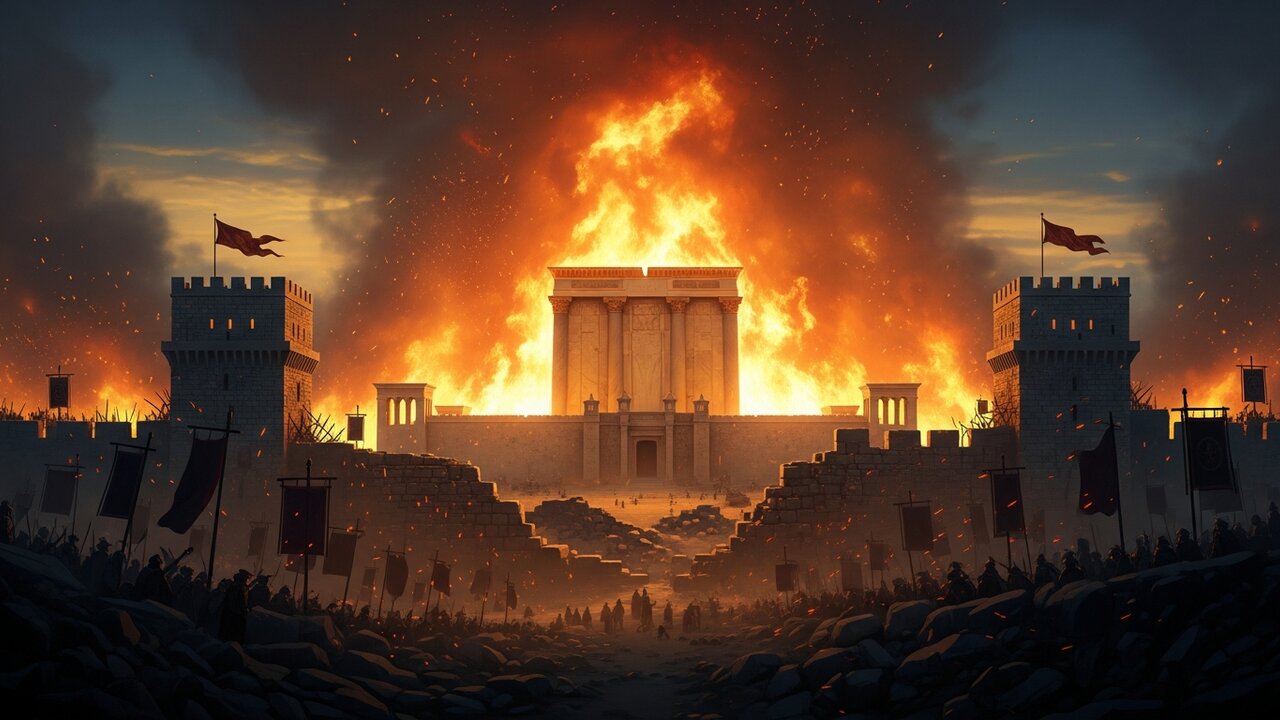
Vespasian was the general sent to crush the Jewish revolt before Nero's death drew him back to Rome as emperor; he handed the siege of Jerusalem to his son Titus. In AD 70, exactly as Jesus had predicted, the Temple was destroyed — with catastrophic loss of life, according to the ancient historian Josephus, though modern historians debate his numbers. Temple-centered worship gave way to rabbinic Judaism, Jewish believers were scattered, and the movement became increasingly Gentile. This is the hinge between Acts and Revelation — the moment the young Messianic movement began visibly separating from the Judaism practiced before AD 70.
Domitian: From "Are You Jewish?" to "Who Is Your Lord?"
I, John... was on the island called Patmos on account of the word of God and the testimony of Jesus.
— Revelation 1:9
Domitian is the emperor behind the book of Revelation. Where Nero's persecution had been a localized, reactive burst of violence, Domitian pursued something more systematic: an insistence on loyalty to the imperial cult itself. Declaring "Jesus is Lord" instead of "Caesar is Lord" was no longer just unusual — it was politically dangerous. According to early tradition, John was arrested, exiled to the island of Patmos, and there received the vision recorded in Revelation.
The Tax That Became an Interrogation
Domitian's pressure on believers didn't come only through open violence. It came through an old, ordinary-sounding tax — the Fiscus Judaicus — that became a tool for sorting out exactly who was loyal to Rome and who wasn't.
Before AD 70, every Jewish man paid an annual half-shekel tax that supported the Temple in Jerusalem. After Titus destroyed the Temple, Vespasian redirected that same tax — Jews now paid it to fund the Temple of Jupiter Capitolinus in Rome. For observant worshipers of Israel's God, that was a bitter humiliation: forced support for the very pagan god whose empire had just destroyed His own Temple.
Domitian enforced this tax far more aggressively than his predecessors. Roman officials investigated anyone suspected of quietly "living like a Jew" in order to determine who owed it. The Roman historian Suetonius describes exactly this kind of investigation — people examined for Jewish practices to establish tax liability.
Three Groups Rome Couldn't Sort
By the AD 90s, Roman officials were trying to categorize three overlapping groups, and none of them fit cleanly.
- Traditional Jews — kept Torah, attended synagogue, paid the tax. Rome understood this group.
- Jewish believers in Yeshua — also kept Torah, Sabbath, and the biblical festivals, and looked exactly like Jews to Roman officials, except that they also proclaimed a second King.
- Gentile believers — increasingly adopting monotheism, Sabbath, dietary practices, and the biblical holy days, while refusing to sacrifice to Roman gods, so that officials suspected they had effectively "become Jews."
From Rome's perspective, this wasn't a private religious matter. An official asking why growing numbers of Romans refused to sacrifice to the emperor wasn't hearing "we've joined a new religion" — he was hearing "we serve the God of Israel, and Jesus is our King." That answer sounded like disloyalty.
It cut both ways. Judaism was religio licita — an officially tolerated religion, exempt from many civic obligations including emperor worship. Believers recognized as Jewish could claim that protection, but still raised suspicion by proclaiming Jesus as King. Believers not recognized as Jewish lost the protection altogether. There was no comfortable position to occupy.
This is the environment in which John's exile makes sense. His "testimony of Jesus" wasn't simply a personal faith story — in that political climate, it was a public confession of allegiance to someone other than Caesar, and Rome treated it as exactly that.
Why This Matters for Reading Revelation
Track the progression across these eight reigns and a pattern emerges. Augustus claimed to bring peace. Tiberius claimed imperial authority. Caligula wanted worship. Nero became the archetype of the tyrant-persecutor. Domitian demanded loyalty and divine honors as policy. Set that progression next to Revelation and the contrast becomes the whole point of the book:
- Rome says Caesar is lord. John says Jesus is Lord.
- Rome demands worship of the emperor. Revelation calls for worship of the Lamb.
- Rome promises peace through military power. Revelation promises peace through the returning King.
That contrast is why Revelation's imagery would have landed with such force on its first hearers. It wasn't primarily a puzzle about the far future — it was a declaration, to congregations under real pressure, that despite every appearance of Rome's power, ultimate authority already belonged to God and to His Messiah.
...I worship the God of our fathers, believing everything laid down by the Law and written in the Prophets.
— Acts 24:14
It's also worth remembering what the earliest believers were not trying to do. The apostles were Jews. They worshiped in the Temple while it stood and kept the biblical feasts. Paul himself testified that he worshiped "the God of our fathers" and believed "everything laid down by the Law and written in the Prophets." Gentile believers, in turn, were being drawn toward Israel's God and adopting Israel's patterns of life — not to become ethnic Jews, but as disciples of Israel's Messiah. Rome's confusion about how to classify these people was, in a strange way, evidence that something genuinely new — and genuinely rooted in the God of Israel — was taking shape.
That's the tension Revelation was written into: faithful to the God of Israel, confessing Yeshua as Messiah, and facing an empire that demanded ultimate loyalty to Caesar. The next post in this series will pick up where this one leaves off — stepping into Revelation itself to see how John answers that pressure.
Frequently Asked Questions
Did Rome persecute Christians the same way throughout the first century?
No. Persecution developed in stages. Under Augustus and Tiberius, Rome showed little direct interest in Jesus' followers. Under Nero, it became violent but localized to Rome. Under Domitian, it became more systematic and ideological, built around demanding loyalty to the imperial cult empire-wide.
What was the Fiscus Judaicus, and why did it matter to believers in Jesus?
It was the tax that once funded the Jerusalem Temple, redirected by Vespasian after AD 70 to fund the Temple of Jupiter in Rome. Domitian enforced it aggressively, and the investigations used to determine who owed it became a tool for identifying anyone — Jewish or Gentile — living according to the God of Israel rather than Rome's gods.
Why is Nero connected to the "number of the beast" in Revelation?
Many scholars note that Nero's name and title can be rendered as 666 using Hebrew gematria, and see this as a deliberate echo in Revelation. Interpretations of this detail differ across Christian traditions, but Nero's reputation as the archetypal persecutor of believers is widely recognized regardless of how that specific number is read.
Did early Jewish believers in Jesus see themselves as separate from Judaism?
No — not in the earliest period. The apostles worshiped in the Temple, kept the biblical feasts, and understood themselves as faithful to the God of Israel. The visible separation between the Messianic movement and the wider Jewish community developed gradually, accelerating after the Temple's destruction in AD 70.
Why was John exiled to Patmos?
According to early tradition, John was exiled under Domitian because of his "testimony of Jesus" — a public confession of loyalty to Yeshua that Roman authorities read as defiance of the emperor's claim to ultimate loyalty.
What is Revelation's core message in its original historical setting?
That despite Rome's apparent power and its demand for worship, ultimate authority already belongs to God and to His Messiah. It called struggling first-century congregations to remain faithful under pressure, with the confidence that the Lamb, not Caesar, holds the future.
Continue the Journey
This post lays the historical groundwork for a series exploring how the early church's relationship with Rome shaped the New Testament — and how that same story connects to Israel's ongoing role in God's unfolding plan. If these themes resonate, you may want to explore related posts on the site, including Fall Into Formation, Every Link in the Chain, and The Center Holds, which trace how these threads of Scripture and history connect across the whole of God's story.
You may also enjoy FFOZ's teaching series on the Second Temple period and the Roman world of the New Testament — a wonderful companion for anyone wanting to go deeper into this history.
Church History Series
Next: Part 2 — The Great Separation: How Church Fathers and Rabbis Pulled Two Communities Apart →