When Theology Became Law: How Constantine Finished What Fear Started
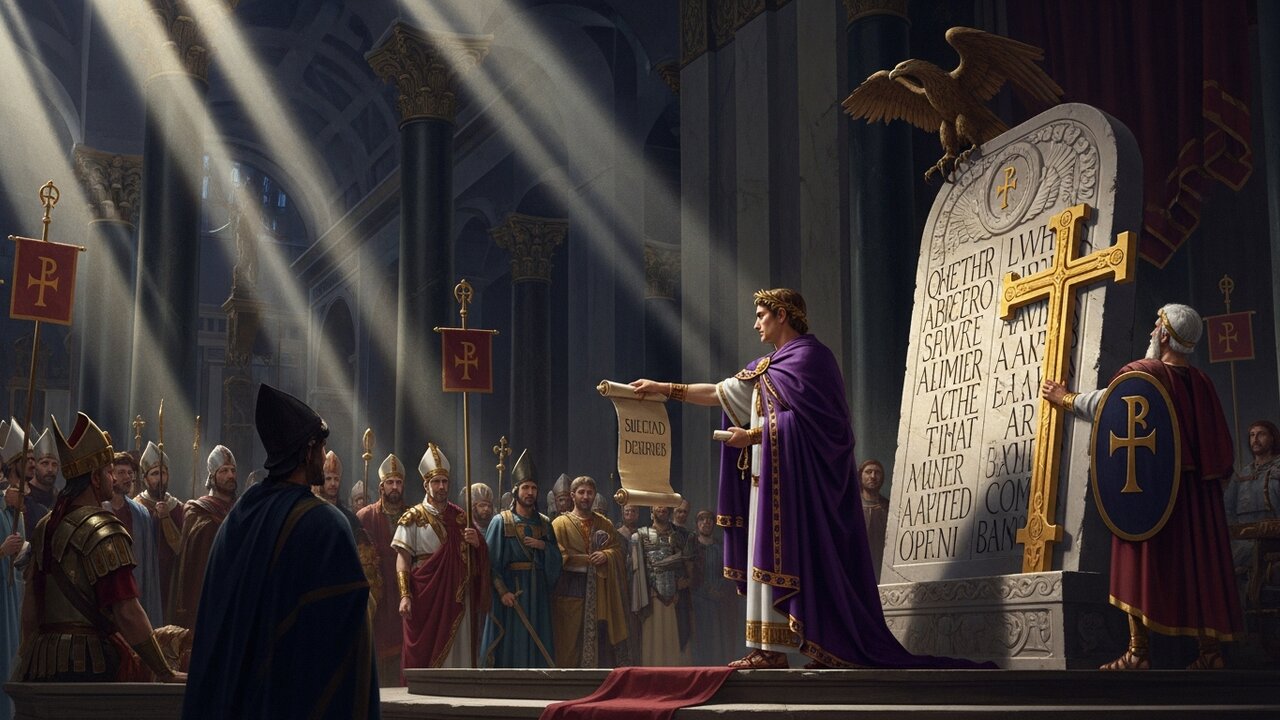
The Relationship Between Israel, the Church, and Political Power · Part 3 (AD 135–325)
Part 1 traced how Rome's emperors moved from indifference to organized persecution. Part 2 traced how church fathers and rabbis, responding to real pressures on both sides, gradually pulled two once-united communities apart. By the early second century, that separation was well underway — but it was still informal. No law required it. No emperor enforced it. It was the accumulated weight of a hundred small decisions, on both sides of the divide.
This post covers the next 190 years — the stretch in which that informal, organic separation hardened into imperial law. And it's worth being precise about something easy to blur: what happened during this period and why it happened are two different questions. The historical events — a banished city, a codified law code, a church council, an emperor's decree — are matters of record. The theological reasoning behind them — what each side believed was at stake, and why they concluded what they concluded — is a separate thread that runs underneath the events, sometimes driving them and sometimes simply excusing them. This post tries to hold both threads without letting either one stand in for the other.
Key Takeaways
- Hadrian's suppression of the Bar Kokhba Revolt (135 AD) physically removed Jewish leadership from the Jerusalem church, ending a century-long line of Torah-observant Jewish bishops and shifting the church's center of gravity toward Gentile, Greco-Roman interpretation.
- Rabbinic Judaism stabilized around the same period through the Mishnah (c. 200 AD) — a project aimed primarily at Jewish survival without a Temple, not at answering Christianity, but one that left no theological room for Torah's obsolescence.
- The Council of Elvira (c. 305 AD) marks the first clear shift from theologians debating doctrine to church leadership legislating social isolation — banning intermarriage and shared meals with Jews at a local, pre-imperial level.
- Constantine's legalization of Christianity (313 AD) handed the church, for the first time, real political power — introducing a temptation the apostolic and even the ante-Nicene church had never faced.
- The Council of Nicaea (325 AD) detached the celebration of the resurrection from the Jewish calendar, and Constantine's own surviving letter shows this was framed in explicitly anti-Jewish language, not neutral calendar reform.
- By Constantine's death, three centuries of theological drift (Part 2) combined with two centuries of political and social pressure (this post) to make a Torah-observant Jewish follower of Jesus, worshiping inside a synagogue, essentially unthinkable within the empire's church.
Phase 1: Jerusalem Erased (135 AD)
What Happened
The Bar Kokhba Revolt was the Jewish people's last major attempt to regain political independence from Rome. When it collapsed, Hadrian didn't simply punish the rebels — he moved to erase Judea's Jewish identity from the map itself. He renamed the province Syria Palaestina, likely invoking the ancient Philistines as part of a deliberate effort to sever the land's name from the people who had rebelled. He rebuilt Jerusalem as Aelia Capitolina, a pagan Roman colony dedicated to Jupiter, and barred Jews from entering the city except on limited occasions, according to several ancient sources.
Why It Mattered Theologically
For over a century, the Jerusalem church had been led by Jewish bishops beginning with James, the brother of Jesus — men who spoke Hebrew or Aramaic, kept Torah, celebrated the biblical feasts, and confessed Yeshua as Messiah while living fully as Jews. Hadrian's ban ended that line abruptly. Marcus became the first entirely Gentile bishop of Jerusalem, not by theological decision but by simple physical necessity: there were no Jews left in the city to lead it.
This is worth sitting with, because it's a case where politics, not theology, did the initial damage. No council decided the apostolic model was wrong. Rome simply made it impossible to practice in the one city where it had always been centered. The church's interpretive center of gravity shifted toward Greek and Roman categories — not because someone argued Torah was obsolete, but because the people best equipped to model Torah-observant faith in Yeshua had been physically removed from the conversation.
Phase 2: Judaism Anchors Itself Without a Temple (c. 200 AD)
What Happened
While Christianity was becoming steadily more Gentile, Rabbi Judah ha-Nasi led the compilation of the Mishnah around AD 200 — the written foundation later generations would build into the Talmud.
Why It Mattered Theologically
It's important to be accurate about the Mishnah's purpose: it wasn't primarily written to answer Christianity. It answered a more urgent question facing every Jew in the empire — how do you keep God's covenant when there is no Temple, no sacrifices, no central altar? The rabbis' answer made Torah portable: study, prayer, synagogue, and daily obedience replaced what sacrifice had once carried. From their perspective, abandoning Torah wasn't a live theological option — it was abandoning the covenant itself. The Mishnah drew a firm boundary around Jewish practice, and that boundary, simply by existing, left no room inside it for a Judaism that included belief in Jesus as Messiah or a changed Torah.
Phase 3: Two Communities Stop Sharing Life (Third Century)
By the AD 200s, Jews and believers in Jesus rarely worshiped together anywhere in the empire. They followed different calendars, celebrated different festivals, answered to different leadership, and were raised inside different educational systems. Even where both communities still read the same Hebrew Scriptures, they now did so inside separate interpretive worlds. This is the point where the split stopped being merely theological and became cultural — children on both sides were simply growing up without knowing the other community existed as anything but a rival.
Phase 4: The Council of Elvira — Doctrine Becomes Policy (c. 305 AD)
What Happened
Held in Hispania (modern Spain), the Council of Elvira is one of the earliest surviving records of Christian leadership passing formal anti-Jewish legislation. Its canons forbade Christians from intermarrying with Jews, sharing meals with Jews, or having their fields blessed by Jews.
Why It Mattered Theologically
This is the hinge point where theology stops being merely argued and starts being enforced — even before Constantine, and even before the church had any imperial power to back it up. Elvira wasn't an emperor's decree; it was local church leadership deciding that ordinary, everyday social contact with Jews — a shared meal, a blessed field, a marriage — was itself spiritually dangerous enough to legislate against. The theological drift chronicled in Part 2 (Torah as obsolete) had, by this point, hardened into a practical policy of social isolation, entirely apart from Rome's involvement.
Phase 5: Christianity Gains the Empire (312–313 AD)
What Happened
After defeating Maxentius at the Battle of the Milvian Bridge in 312, Constantine attributed his victory to the God of the Christians. In 313, the Edict of Milan — issued by Constantine alongside co-emperor Licinius — legalized Christianity across the empire and ended imperial persecution.
Why It Mattered Theologically
The church moved, almost overnight, from illegal, to tolerated, to increasingly favored. For the first time, bishops advised emperors and imperial money built churches. This was a genuine blessing in many respects — but it introduced a temptation the church had never faced in its first three centuries. Enduring political power under persecution required faithfulness. Possessing political power required something the apostolic and ante-Nicene church had comparatively little practice with: restraint.
Phase 6: Nicaea — Unity Through Uniformity (325 AD)
What Happened
Constantine wanted religious unity because religious division threatened imperial unity. One question before the Council of Nicaea was when Christians should celebrate the resurrection. Many believers, especially across Asia Minor — known as Quartodecimans — continued observing Jesus' death and resurrection in connection with Passover, on the 14th of Nisan, following the Jewish calendar. Others favored a fixed Sunday observance. Nicaea endorsed the Sunday practice, and over time the church developed a way to calculate Easter's date independent of Jewish calendrical reckoning altogether.
Why It Mattered Theologically — In Constantine's Own Words
This is where the historical and theological threads meet most starkly, because Constantine's own surviving letter to the churches after the council removes any doubt about the motivation behind decoupling Easter from Passover. It wasn't calendar mathematics. It was explicit religious hostility, stated in imperial language:
It appeared an unworthy thing that in the celebration of this most holy feast we should follow the practice of the Jews... Let us then have nothing in common with the detestable Jewish crowd; for we have received from our Saviour a different way.
— Constantine, Letter on the Keeping of Easter, 325 AD
This single document is one of the clearest places in this whole history where the “what” and the “why” line up exactly. The historical act — changing how a date is calculated — was, in the emperor's own explanation, driven by an explicitly theological and ethnic hostility toward Jews, not a religiously neutral administrative decision. That matters for reading this history honestly: the separation of Easter from Passover wasn't simply the natural maturing of Christian identity. By Constantine's own account, it was meant as a repudiation.
Phase 7: Theology Becomes Law
Before Constantine, church fathers wrote books people could accept, debate, or ignore. After Constantine, emperors wrote laws people had to obey. That shift changed the stakes of every theological conclusion the church had already reached.
In 315, Constantine made it a capital offense for a Jew to convert a Gentile to Judaism, while also making it illegal for a Jew to retaliate against a fellow Jew who converted to Christianity. Not every later restriction began under Constantine himself — several developed further under his successors — but together this body of law reinforced a separation that had, until now, been social and theological rather than criminal.
In 321, Constantine issued a civil decree establishing the “venerable Day of the Sun” as a day of rest for many urban occupations across the empire. It's worth being precise here too: this was not an imperial command abolishing the biblical seventh-day Sabbath. It was a Roman civil law establishing Sunday as a public day of rest, and many Christians — especially in the East — continued recognizing the Sabbath in various ways alongside a Sunday gathering to commemorate the resurrection. But over the following decades, Sunday increasingly displaced Sabbath observance across much of the church. The shift was gradual, not instantaneous — but the direction was now backed by Roman law rather than simply church custom.
Separating the History From the Theology
Here is the distinction this post has tried to hold onto throughout: almost none of these historical events, by themselves, required the theological conclusion the church eventually reached. Hadrian banned Jews from Jerusalem for political reasons — to punish a revolt and erase a national identity, not to settle a doctrinal dispute. Constantine wanted a religiously unified empire — an administrative goal that could, in principle, have been achieved without hostility toward Judaism specifically. Politics supplied the pressure and the machinery. It did not, by itself, supply the theology.
The theology came from somewhere else — from the drift already underway among Ignatius, the Epistle of Barnabas, Justin Martyr, Melito, Irenaeus, Tertullian, and Origen, traced in Part 2 of this series. By the time Constantine held the political power to legislate, the church had already spent two centuries concluding that Torah was obsolete for everyone, not simply unrequired for Gentiles. Constantine didn't invent that theology. He gave it the force of Roman law — and his own letter on Easter shows he was not a reluctant, neutral administrator, but an active participant who found the theological hostility toward Judaism useful for his political goal of imperial unity.
That's the honest way to hold these two threads together: the demographic shift toward a Gentile-majority church (accelerated by Hadrian's ban on Jewish leadership in Jerusalem), the theological drift toward viewing Torah as obsolete (traced through the church fathers), and the political opportunity of imperial favor (arriving under Constantine) reinforced one another. None of the three alone produced the final separation. Together, over roughly two hundred fifty years, they did.
| What Happened (History) | Why It Happened (Theology) |
|---|---|
| Hadrian bans Jews from Jerusalem; Marcus becomes first Gentile bishop (135) | Loss of Jewish leadership removed the apostolic model from the church's center of gravity |
| Mishnah codified under Judah ha-Nasi (c. 200) | Rabbinic Judaism defines Torah-fidelity as covenant survival itself, with no room for a superseded Torah |
| Council of Elvira bans intermarriage, shared meals with Jews (c. 305) | Church leadership concludes ordinary social contact with Jews is itself spiritually dangerous |
| Edict of Milan legalizes Christianity (313) | The church moves from enduring political power to holding it — and using it |
| Nicaea decouples Easter from the Jewish calendar (325) | Independence from Jewish calculation becomes a symbol of the church's separate identity |
| Imperial laws restrict conversion to Judaism; Sunday established as civil rest day (315–321) | A century of theological conviction that Torah was obsolete now has the force of Roman law behind it |
Looking Back
Around AD 30, the church looked Jewish. The apostles worshiped in the Temple and debated Torah inside Jerusalem. Around AD 325, the church looked Roman. The bishops met in imperial basilicas and debated philosophy inside imperial councils. Neither transformation happened in a single generation, and neither happened through a single cause. It took nearly three hundred years, and it took politics and theology working together — sometimes reinforcing each other, sometimes simply running in parallel.
Frequently Asked Questions
What was Aelia Capitolina, and why does it matter for church history?
Aelia Capitolina was the pagan Roman colony Hadrian built on the site of Jerusalem after crushing the Bar Kokhba Revolt in 135 AD, dedicated to Jupiter. Jews were largely barred from entering it. Because Jerusalem's church had been led by Torah-observant Jewish bishops for over a century, this ban ended that leadership line and shifted the church's center of gravity toward Gentile, Greco-Roman interpretation.
Did Constantine invent Christian hostility toward Judaism, or inherit it?
He inherited it. The theological drift toward viewing Torah as obsolete developed over the preceding two centuries through figures like Justin Martyr, Melito, Irenaeus, Tertullian, and Origen. Constantine's contribution was giving that existing theology the force of Roman law, and his surviving letter on Easter shows he actively embraced and amplified the hostility rather than merely inheriting it passively.
What was the Quartodeciman controversy?
Quartodecimans were believers, especially in Asia Minor, who continued observing Jesus' death and resurrection on the 14th of Nisan, following the Jewish Passover calendar. The Council of Nicaea in 325 sided against this practice, establishing a fixed Sunday observance calculated independently of the Jewish calendar.
Did Constantine abolish the biblical Sabbath?
Not directly. His 321 AD decree established Sunday as a civil day of rest across the empire; it did not explicitly command believers to stop observing the seventh-day Sabbath, and many Christians, particularly in the East, continued to recognize it alongside Sunday worship. Over subsequent decades, however, Sunday gradually displaced Sabbath observance in much of the church.
What was the Council of Elvira, and why is it significant?
A local church council held in Hispania around 305 AD, Elvira is one of the earliest records of church leadership formally legislating social separation from Jews — banning intermarriage and shared meals. It shows the separation hardening into enforced policy before Constantine or any imperial law was involved.
Was the separation between the church and the synagogue mainly theological or mainly political?
Both, working together over roughly two hundred fifty years. Political events — Hadrian's ban on Jews in Jerusalem, Constantine's rise to power — removed Jewish leadership and created the machinery for legal enforcement. Theological developments — the church fathers' gradual conclusion that Torah was obsolete — supplied the content that machinery eventually enforced. Neither cause fully explains the outcome without the other.
Looking Ahead
The story doesn't end with separation. Over the past century, something remarkable has been unfolding: Jewish people have begun rediscovering Yeshua — not as the founder of a new religion, but as the Jewish Messiah of Israel — while many Christians have begun rediscovering the Jewish context of Jesus, the apostles, and the New Testament itself. Messianic Jewish congregations have emerged worldwide, seeking to live as Jewish followers of Yeshua rooted in the Scriptures of Israel, and many Gentile believers have developed a renewed appreciation for their faith's Jewish roots — not by adopting Jewish identity or obligations, but by reading Scripture in its original context.
Whatever one makes of every detail of the modern Messianic movement, it represents something historically remarkable: after nearly eighteen centuries of increasing distance, Jews and Christians are once again talking to one another about the Jewish Messiah. That recovery — and the modern misunderstandings still standing in its way — is where this series turns next.
Continue the Journey
This is Part 3 of a series tracing how the church separated from its Jewish roots. Part 1 covers the Roman imperial pressure building from Augustus through Domitian; Part 2 covers the theological drift among the church fathers and the rabbinic response. You may also want to explore related posts on the site, including Fall Into Formation, Every Link in the Chain, and The Center Holds, which trace these same threads of Scripture and history across the whole of God's unfolding story.
For deeper study on this period, FFOZ's Torah Club offers excellent teaching on the Jewish context of the early church and the historical roots of this separation.