From Exile to Restoration: The Return of Israel
The Relationship Between Israel, the Church, and Political Power · Part 6 (AD 1492–1948)
Part 5 ended with the Alhambra Decree — the expulsion that closed a thousand years of Jewish civilization in Spain in a matter of months. It would be reasonable to expect the story from here to simply continue downward. In some very real ways, it does: this post covers a ghetto, a massacre that rivals anything before the Holocaust, and the Holocaust itself. But it also covers something the previous five posts in this series haven't had occasion to cover yet — emancipation, return, and after nearly nineteen centuries, restoration.
This is the post where the arc of the whole series bends. Not because the suffering stops — it doesn't, and this post won't soften it — but because for the first time since Rome, the story starts moving in the other direction.
Key Takeaways
- The Alhambra Decree scattered Spain's Jewish civilization across the Ottoman Empire, North Africa, Italy, and Holland; Sultan Bayezid II reportedly welcomed many refugees, though the exact wording of his famous remark about Ferdinand is debated among historians.
- Martin Luther's relationship with the Jewish people reversed dramatically — from his hopeful 1523 appeal for kind treatment to his virulent 1543 call for violence against synagogues and homes — and his later writings would be cited by antisemites centuries after his death, even though they arose from a sixteenth-century theological dispute rather than modern racial ideology.
- Venice's 1516 ghetto gave the word itself to history and formalized a pattern — segregation rather than extermination — that traces directly back to Augustine's Witness Doctrine from Part 4.
- Poland-Lithuania became the world's largest and, for a time, safest center of Jewish life after the western expulsions, until the 1648 Chmielnicki massacres devastated it — a catastrophe many Jewish communities responded to by expecting the Messianic age was near.
- The Enlightenment and French Revolution produced something unprecedented in nearly fifteen centuries: Jews could become full citizens of a European nation without converting to Christianity.
- The 1894 Dreyfus Affair convinced Theodor Herzl that assimilation could never fully solve antisemitism, launching the Zionist movement at the First Zionist Congress in 1897.
- The Holocaust murdered six million Jews and destroyed centuries-old centers of European Jewish life; while many individual Christians risked their lives to rescue Jews, much of Christian Europe failed to prevent or effectively resist the genocide — a more precise claim than saying Christian civilization caused it.
- In 1948, David Ben-Gurion's declaration restored Jewish political sovereignty for the first time in nearly two thousand years — a turning point that changed Jewish existence whether viewed religiously, historically, or politically.
A Quick Timeline
| Year | Milestone | Significance |
|---|---|---|
| 1492 | Alhambra Decree aftermath | Spanish Jewish civilization scatters to the Ottoman Empire, North Africa, Italy, and Holland |
| 1516 | First ghetto (Venice) | Legally required Jewish quarter gives the word “ghetto” its origin; segregation becomes formal policy |
| 1517–1543 | The Reformation and Luther | Western Christendom fractures; Luther's hopeful early outreach curdles into virulent hostility |
| 1500s–1600s | Poland-Lithuania rises | Becomes the largest, and for a time safest, center of Jewish population and scholarship in the world |
| 1648 | Chmielnicki massacres | Cossack uprising devastates Polish Jewish communities; among history's worst disasters before the Holocaust |
| 1700s | Hasidism emerges | The Baal Shem Tov's movement brings joy and accessible devotion out of communal trauma |
| 1789 | French Revolution | France emancipates Jews as citizens for the first time in nearly fifteen centuries — without requiring baptism |
| 1800s | Pale of Settlement / pogroms | Russia moves the opposite direction from Western Europe; mass Jewish emigration follows |
| 1894–1897 | Dreyfus Affair / First Zionist Congress | A French court case convinces Herzl that only a Jewish homeland can answer antisemitism |
| 1917 | Balfour Declaration | Britain endorses “a national home for the Jewish people” as international policy |
| 1939–1945 | The Holocaust | Six million Jews murdered; centuries-old centers of European Jewish life destroyed |
| 1948 | State of Israel declared | Jewish political sovereignty restored after nearly two thousand years |
Phase 1: The End of Medieval Spain (1492)
The Alhambra Decree didn't simply expel a religious minority. It ended one of the greatest centers of Jewish civilization in history — a nearly thousand-year tradition that had produced Maimonides, Judah Halevi, Abraham ibn Ezra, and generations of Jewish physicians, astronomers, and biblical scholars. Within months, that civilization scattered: to the Ottoman Empire, North Africa, Italy, and Holland.
There's a striking historical footnote here. Muslim Sultan Bayezid II reportedly welcomed large numbers of these Jewish refugees into Ottoman territory, and is remembered for criticizing King Ferdinand for impoverishing Spain by driving out such valuable subjects — though historians debate the exact wording of the quotation attributed to him. Whatever his precise words, the Ottoman Empire's willingness to absorb Spain's exiled Jewish population stands in sharp contrast to what Catholic Europe had just done.
Phase 2: The Protestant Reformation (1517)
This deserves its own extended treatment, because the Reformation shattered something that had held since Constantine: the religious unity of Western Christendom. For the first time in over a thousand years, Western Christianity itself fractured into competing branches.
Martin Luther's Reversal
Luther's own relationship with the Jewish people is one of the starkest contrasts in this entire series. In his early work That Jesus Christ Was Born a Jew (1523), he hoped that Jewish readers, encountering what he believed was a rediscovered, purified Gospel free of medieval Catholic corruption, would finally embrace it — and he urged Christians to treat Jewish people kindly in the meantime.
Widespread Jewish conversion never came. Luther's tone changed dramatically. By 1543, in On the Jews and Their Lies, he called for burning synagogues, destroying Jewish homes, and confiscating religious books. These later writings would be cited by antisemites centuries afterward — though it's historically important to note they arose out of Luther's own sixteenth-century theological frustration and disputation, not out of the racial ideology that would weaponize them far later. Both halves of Luther's story are true, and both matter for understanding how deeply this history runs.
Phase 3: The First Ghetto (1516)
A year before Luther's reforming movement began, Venice created the first legally mandated Jewish quarter — walled, gated, and locked at night. The word ghetto comes from this Venetian neighborhood, and many Catholic cities soon copied the model.
It's worth naming what this pattern actually was: not extermination, and not full integration, but enforced segregation — the practical, architectural continuation of Augustine's Witness Doctrine from Part 4 of this series. Jewish communities were to be preserved, permitted to survive and even to worship, but kept permanently separate and subordinate. The ghetto gave that centuries-old theological principle a literal wall.
Phase 4: Eastern Europe Becomes the Center of Judaism
As Western Europe expelled and confined its Jewish populations, Poland-Lithuania opened its doors. In the wake of the western expulsions, it became home to the largest Jewish population in the world — and for a significant stretch of time, one of the safest places in Europe to be Jewish. Great academies flourished. Rabbinic scholarship expanded dramatically. For the first time since Spain's golden age, Jewish civilization had a new heart, and it beat in Poland and Lithuania.
Phase 5: The Chmielnicki Massacres (1648)
Then catastrophe struck. A Cossack uprising under Bohdan Chmielnicki tore through Jewish communities across Poland-Lithuania. Modern historians' estimates vary, but tens of thousands of Jews were killed, with many more displaced or forced to flee. In Jewish collective memory, this catastrophe ranks among the greatest disasters in Jewish history before the Holocaust itself. Entire communities that had taken generations to build simply disappeared. In the aftermath, many rabbis concluded that suffering of this magnitude must mean the Messianic age was imminent.
Phase 6: The Rise of Hasidism (1700s)
Trauma often produces renewal, and this is one of the clearest examples in Jewish history. Rabbi Israel ben Eliezer, known as the Baal Shem Tov, introduced a movement emphasizing joy, prayer, God's nearness, and the spiritual dignity of ordinary people rather than elite scholarship alone. Hasidism transformed Jewish religious life across Eastern Europe, shifting spiritual emphasis toward heartfelt, accessible devotion — without abandoning the value of Torah learning that had always anchored Jewish life.
Phase 7: The Enlightenment (1700s)
This changes essentially everything that came before it. For the first time since Constantine, Europe began genuinely separating church from state — and ironically, the same secular ideas that weakened Christianity's public authority also opened doors to Jewish equality that fifteen centuries of Christian rule had never opened.
The French Revolution's ideals of liberty, equality, and citizenship led France to emancipate its Jewish population — as citizens, with no baptism required. This was unprecedented. For the first time in nearly fifteen centuries, a Jew could become a full citizen of a European nation without becoming a Christian.
This opening produced the Haskalah, the Jewish Enlightenment, and with it a debate that continues in Jewish life to this day: should Jews assimilate into the surrounding culture, or remain distinctly separate? Emancipation didn't resolve Jewish identity — it made the question urgent in a way it had never needed to be under enforced ghetto walls.
Phase 8: Russia Goes the Other Direction
While Western Europe liberalized, Russia moved the opposite way. Thanks to the Pale of Settlement, millions of Jews were legally confined to a defined western region of the Russian Empire. After the assassination of Tsar Alexander II in 1881, waves of pogroms devastated Jewish communities, and the subsequent May Laws deepened legal discrimination further. Between the 1880s and the outbreak of World War I, millions of Jews emigrated — overwhelmingly to the United States — reshaping the demographic center of world Jewry yet again.
Phase 9: The Dreyfus Affair (1894)
This deserves major emphasis, because the modern State of Israel's origins trace back to a single French courtroom. Captain Alfred Dreyfus was French, educated, patriotic, and thoroughly assimilated into French society. He was falsely convicted of treason anyway, and Theodor Herzl — a journalist covering the trial — watched crowds outside the courtroom shout “Death to the Jews.”
Herzl reached a conclusion that would reshape Jewish history: assimilation, no matter how complete, would never fully solve antisemitism. Only a Jewish homeland could offer real security. He convened the First Zionist Congress in Basel in 1897, and afterward wrote what became one of the most consequential sentences in modern Jewish history.
At Basel I founded the Jewish State.
— Theodor Herzl, diary entry, 1897
Most people who heard the claim at the time laughed. Fifty-one years later, Israel existed.
Phase 10: World War I and the Balfour Declaration
The First World War brought down the Ottoman Empire, and Britain received the Mandate for Palestine in its aftermath. In 1917, the British government issued the Balfour Declaration, formally endorsing the idea of a Jewish homeland while also affirming the rights of the region's existing non-Jewish communities.
His Majesty's Government view with favour the establishment in Palestine of a national home for the Jewish people, it being clearly understood that nothing shall be done which may prejudice the civil and religious rights of existing non-Jewish communities in Palestine.
— Balfour Declaration, 1917
For the first time since the Roman era, the restoration of the Jewish people to their ancestral land was being discussed by world powers as a matter of formal international policy — not merely as a hope preserved in prayer and Scripture, but as a live diplomatic question.
Phase 11: The Holocaust
This is the emotional center of this entire post, and nothing in Jewish history compares to it. Six million Jews were murdered. Communities centuries old, some traced back to the very migrations covered earlier in this series, vanished. The great centers of European Jewish life — built, rebuilt, and sustained across everything this series has already traced, from Rhineland massacres to Chmielnicki to the Pale of Settlement — ceased to exist within a few catastrophic years.
It's worth stating the historical claim here with real precision, because imprecision does a disservice to both the victims and the truth. Many individual Christians took extraordinary personal risk to rescue Jewish neighbors, and some churches spoke out against the genocide as it unfolded. At the same time, much of Christian Europe failed to prevent, or failed to resist effectively enough, what was happening. That is a different and more historically accurate claim than saying Christian civilization caused the Holocaust. The ideology behind the genocide was rooted in modern racial pseudo-science, not medieval Catholic theology — but centuries of the patterns this series has traced, from Birkat ha-Minim to the ghetto to Limpieza de Sangre, had already normalized treating Jewish people as a permanently separate, suspect category. That normalization didn't cause the Holocaust. It didn't prevent it either.
He who keeps Israel will neither slumber nor sleep.
— Psalm 121:4
Phase 12: 1948
Everything reverses. For nineteen hundred years, Jewish history had largely been a story of expulsion, dispersion, and survival against overwhelming odds — the very pattern this entire series has traced from Hadrian's ban on Jerusalem to the Alhambra Decree to the death camps of Europe. Now, history became a story of return.
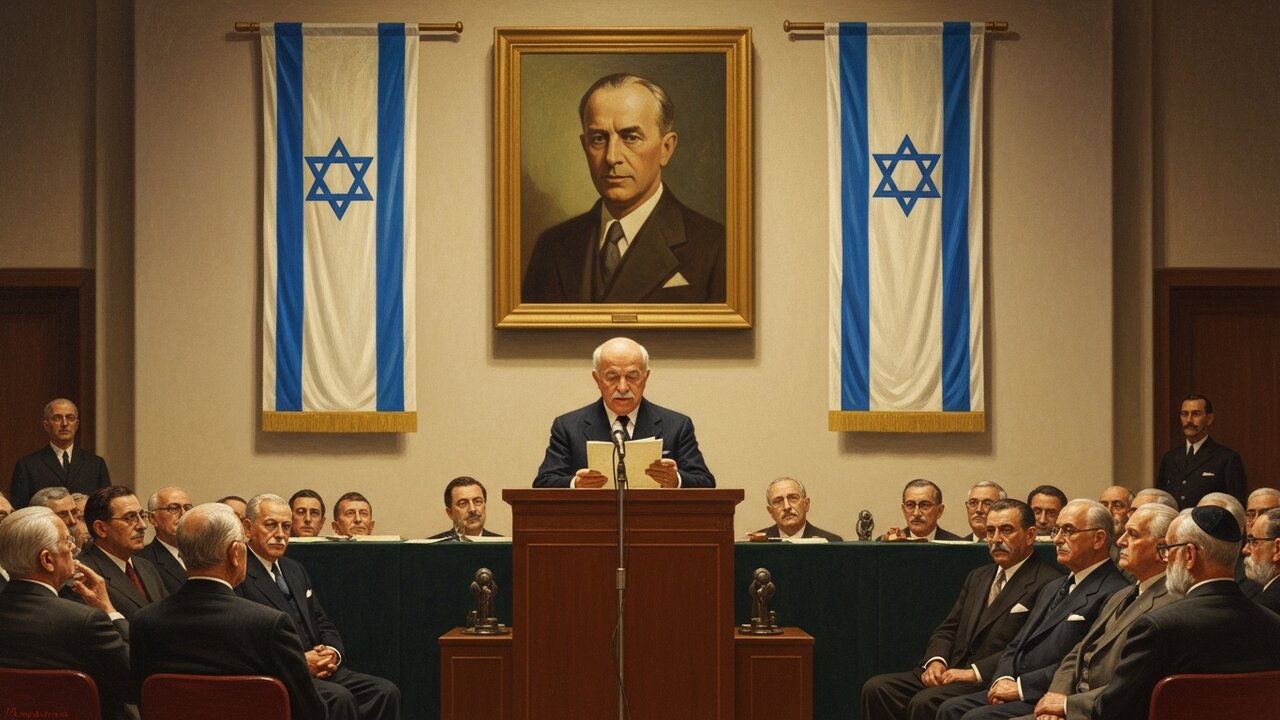
On May 14, 1948, David Ben-Gurion read the Declaration of the Establishment of the State of Israel. Whether one approaches this moment through a religious, historical, or political lens, it fundamentally changed Jewish existence: the restoration of Jewish political sovereignty in the land of Israel, after nearly two thousand years without it.
Why This Post Is Different
Every post in this series so far has traced a story moving in one direction — from unity toward separation, from tolerance toward restriction, from persecution toward greater persecution still. This post contains real horror — Chmielnicki, the ghetto, the Holocaust — and doesn't minimize any of it. But it also contains something genuinely new in this series: emancipation that didn't require conversion, a homeland reestablished after nineteen centuries, and a people who, after everything this series has documented, still exist, still worship, and as of 1948, once again govern themselves in their own land.
Frequently Asked Questions
Did Martin Luther's writings directly cause the Holocaust?
No. Luther's 1543 writings emerged from a specific sixteenth-century theological dispute, centuries before the racial ideology behind Nazism existed. However, his later antisemitic writings were cited by antisemites in the centuries that followed, including by Nazi propagandists, which is why his reversal from his earlier, more hopeful 1523 writing remains historically significant to trace.
What was the first ghetto, and where does the word come from?
Venice created the first legally mandated, walled Jewish quarter in 1516, and the word “ghetto” originates from this Venetian district. The model — segregation rather than expulsion or extermination — was soon adopted by other Catholic cities across Europe.
Why did Poland-Lithuania become the center of Jewish life after the Spanish expulsion?
As Western European nations expelled their Jewish populations, Poland-Lithuania offered relative safety and opportunity, and it became home to the largest Jewish population in the world for centuries, with flourishing rabbinic academies and scholarship, until the Chmielnicki massacres of 1648 devastated the region.
How did the Enlightenment change Jewish legal status in Europe?
The French Revolution emancipated Jews as full citizens without requiring conversion to Christianity — the first time in nearly fifteen centuries this had been possible in a European nation. This unprecedented shift also launched the Haskalah, the Jewish Enlightenment, and an ongoing internal debate over assimilation versus distinct Jewish identity.
What was the Dreyfus Affair, and why did it matter for Zionism?
Captain Alfred Dreyfus, a fully assimilated French Jewish officer, was falsely convicted of treason in 1894. Witnessing the antisemitic crowds at his trial convinced journalist Theodor Herzl that assimilation could never fully solve antisemitism, leading him to found the modern Zionist movement at the First Zionist Congress in 1897.
What did the Balfour Declaration actually say?
Issued by Britain in 1917, it expressed formal support for “a national home for the Jewish people” in Palestine, while also stating that nothing should be done to prejudice the civil and religious rights of the region's existing non-Jewish communities. It marked the first time a major world power formally endorsed Jewish restoration as international policy.
Did Christian civilization cause the Holocaust?
This requires precision. The Holocaust's ideology was rooted in modern racial pseudo-science, not medieval Christian theology, and many individual Christians risked their lives to rescue Jews. However, centuries of Christian European patterns — segregation, legal subordination, and recurring violence traced throughout this series — normalized treating Jews as a permanently separate and suspect people, and much of Christian Europe failed to prevent or effectively resist the genocide once it began. Saying Christian Europe failed to stop it is historically accurate; saying Christian civilization caused it overstates the case.
Why is 1948 considered such a major turning point in Jewish history?
It marks the restoration of Jewish political sovereignty in the land of Israel after nearly two thousand years without it — reversing a pattern of expulsion and dispersion that had defined nearly the entire span of history this series has traced since the Bar Kokhba Revolt.
Continue the Journey
This is Part 6 of a series tracing the relationship between Israel, the Church, and political power, from Rome's earliest persecutions through the modern restoration of Israel. Part 1 covers Roman persecution from Augustus through Domitian; Part 2 covers the theological separation between church and synagogue; Part 3 covers Constantine's institutionalization of that separation; Part 4 covers the rise of Latin Christendom through Charlemagne's coronation; Part 5 covers the Crusades, the Black Death, and the road to the Inquisition. You may also want to explore related posts on the site, including Fall Into Formation, Every Link in the Chain, and The Center Holds, which trace these same threads of Scripture and history across the whole of God's unfolding story.